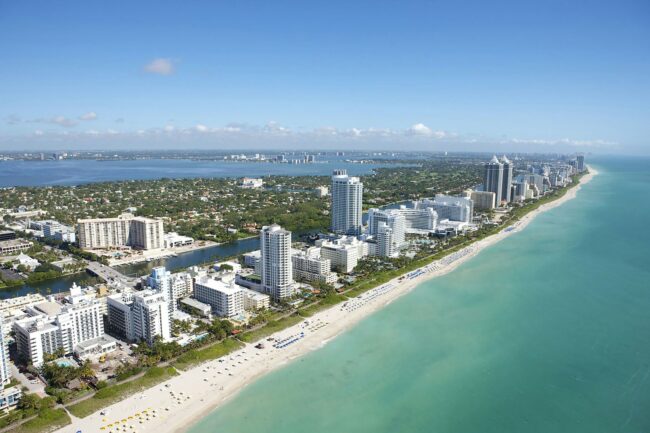
Source: Antonio Cuellar via Unsplash. License: Unsplash License.
Quick Answer: South Florida hotels in 2026 are earning more per room even as they fill fewer of them. Through August, Miami-Dade’s average daily rate was up 12.8% and RevPAR up 10.1%, while occupancy slipped 2.4%. The World Cup lifted rates more than occupancy, and new convention hotels plus a deep luxury deal market set the stage for the 2026-27 winter season.
How is South Florida’s hotel market performing in 2026?
Pricing power is doing the heavy lifting. The pattern is clearest in Miami-Dade, the region’s largest lodging market, where figures compiled by the Greater Miami Convention and Visitors Bureau (GMCVB) from STR data show a market that has traded a few points of occupancy for double-digit rate growth.
Through August 2026, Miami-Dade hotels ran 74.2% occupancy, down from 76.0% in the same period of 2025, a 2.4% decline. Over the same stretch, average daily rate (ADR) climbed to $261.54 from $231.92, up 12.8%, and revenue per available room (RevPAR) rose 10.1% to $193.95. In other words, the county’s hotels collected about $18 more per available room per night than a year earlier, even with roughly one in four rooms going unsold on an average night.
Earlier in the year, Miami-Dade stood out nationally. An analysis by Michael Cheng, dean of Florida International University’s Chaplin School of Hospitality and Tourism Management, published by FIU News in July, reported that through May 2026 Miami-Dade had the highest occupancy of the top 25 U.S. hotel markets at nearly 80%, and the nation’s highest ADR at $293.67, up 11.2% year over year.
How do Miami-Dade’s submarkets compare?
The GMCVB report breaks Miami-Dade into submarkets, and the split is instructive.
| Submarket (Jan-Aug 2026) | Occupancy (YoY) | ADR (YoY) | RevPAR (YoY) |
|---|---|---|---|
| Miami-Dade total | 74.2% (-2.4%) | $261.54 (+12.8%) | $193.95 (+10.1%) |
| Miami Beach | 71.4% (-3.9%) | $340.39 (+14.7%) | $243.10 (+10.1%) |
| Downtown Miami | 75.1% (-0.3%) | $278.28 (+9.7%) | $208.98 (+9.4%) |
| Airport | 80.3% (-2.0%) | $155.63 (+9.8%) | $125.04 (+7.5%) |
Miami Beach’s $340 ADR is roughly $43 above its level a year earlier. Its 71.4% occupancy is the lowest in the table. Downtown’s near-flat occupancy alongside a 9.7% rate gain makes it the most balanced performer.
Why did August look so weak?
August, the heart of the off-season, broke the pattern. For the month, Miami-Dade occupancy fell to 63.6% from 68.8%, a 7.6% decline, while ADR slipped 0.3% to $162.67 and RevPAR dropped 7.9% to $103.43. Miami Beach had the sharpest drop: occupancy fell 12.4% to 58.0% and RevPAR fell 13.9% to $112.99. Downtown RevPAR fell 8.6% and Airport RevPAR fell 6.1%. Rate did not offset softer demand, a reminder that summer pricing power is thinner than in winter.
Did the 2026 World Cup boost South Florida hotels?
Yes, but mostly through price rather than fuller hotels, and less than many operators expected. Miami hosted seven FIFA World Cup matches at Hard Rock Stadium, including a quarterfinal and the bronze final, according to the FIU analysis, and the FIFA Fan Festival at Bayfront Park drew more than 600,000 fans over 24 days.
The hotel numbers tell a mixed story. CoStar data cited by the Miami Herald in late July showed that on game nights and the nights before them, Miami-area revenue per room rose 37% from the prior year. Occupancy on those nights averaged about 73%, down roughly 4%, and ADR averaged $268. For the week ending June 27, the FIU analysis reported Miami’s ADR up 51.1% and RevPAR up 51.6%, with occupancy roughly flat at 73.5%.
HVS, the hospitality consulting firm, measured the tournament against a counterfactual of what the market would have done without it. In an August 6 report covering a market that includes Miami, Fort Lauderdale, Key Biscayne, Hialeah and Hollywood, HVS estimated that occupancy ran 4.6 percentage points below that baseline while ADR was $26.30 higher, producing an 18.9% RevPAR gain and about $34.2 million in incremental rooms revenue.
What did Miami hoteliers say about the World Cup?
Several operators told the Herald that results fell short of the hype. Rates set about 200 days out were three to four times normal, according to analytics firm Lighthouse, then fell almost daily through the group stage. Faena District general manager Said Haykal said of expected demand, “It just didn’t materialize.” Fontainebleau Miami Beach was an exception, reporting revenue growth in June and July.
How did Broward fare during the tournament?
Broward may have been a relative winner as fans spread across the metro. On June 27, the date of the Portugal-Colombia match, CoStar data provided by Visit Lauderdale and reported by Axios showed Broward hotel occupancy up 9.7% and RevPAR up nearly 30% from the same date in 2025. The Fort Lauderdale Downtown Development Authority had estimated World Cup impact of up to $175 million.
How are Broward, Palm Beach and the Keys performing?
| Market | Period | Key reported metrics |
|---|---|---|
| Broward (Greater Fort Lauderdale) | March 2026 | 85% occupancy (+6%), demand +9%, ADR $240.49 |
| Palm Beach County | First half 2026 | 77% average occupancy, room revenue $918M (+11%), 6.09M visitors (+6.4%) |
| Florida Keys | July 2026 | 80.4% occupancy (+6.0%), ADR $297.59 (+3.3%), RevPAR $239 (+9.5%) |
| Miami-Dade | Jan-Aug 2026 | 74.2% occupancy (-2.4%), ADR $261.54 (+12.8%) |
The periods differ, so the table is not a like-for-like ranking, but it captures each county’s most recent published headline figures as reported.
What is driving Broward’s hotel demand?
Visit Lauderdale reported in April that March 2026 occupancy in Greater Fort Lauderdale reached 85%, up 6% from March 2025, with hotel demand up 9% and ADR at $240.49. For all of 2025, the agency said hotel demand rose 1.3%, Tourist Development Tax collections reached $124 million (up 0.3%), and Port Everglades handled more than 4 million cruise passengers, up 16.2%. The Broward County Convention Center booked 48 conventions in 2025, generating about 265,000 hotel room nights.
Not every Broward submarket is strong. Marcus & Millichap’s 2026 Fort Lauderdale hospitality forecast noted that Pompano Beach occupancy fell about 300 basis points in 2025, with economy-oriented areas softening most, while central Fort Lauderdale and the Hollywood-airport area held up better.
Why are the Palm Beaches setting records?
Discover The Palm Beaches data reported by WPTV in September showed Palm Beach County welcomed 6.09 million visitors in the first half of 2026, up 6.4%, with hotel occupancy averaging 77% and room night revenue up 11% to $918 million. Canadian visitation, a sore spot statewide, moved the other way in Palm Beach: Canadian visitors rose almost 2% in the first half while Florida overall fell almost 14%, and in the second quarter the Palm Beaches saw a 12.5% increase. The agency also forecast September lodging demand up 15%.
How did the Florida Keys hold up in summer?
The Monroe County Tourist Development Council’s September partner newsletter showed Keys hotels at 80.4% occupancy in July 2026, up 6.0%, with ADR of $297.59 and RevPAR of $239, up 9.5%. Hotel revenue reached $80.0 million, up 9.4%. Islamorada posted the biggest RevPAR gain at 19.0%, while Marathon led on occupancy at 82.4% and Key West ran 81.9%. Key West International Airport handled 70.9K TSA passengers in July, up 10.5%.
What new hotel supply is entering South Florida?
The biggest addition this year is the 801-room Omni Fort Lauderdale Hotel, which celebrated its grand opening in March 2026. The 29-story hotel sits next to the Broward County Convention Center and offers more than 120,000 square feet of meeting space, including a 30,000-square-foot ballroom. Marcus & Millichap flagged the hotel as a source of near-term supply pressure in the Fort Lauderdale core, even as the expanded convention center is expected to lift group demand.
In Miami-Dade, CoStar reported in January 2026 that Miami had the highest number of hotel rooms under construction in Florida, with upper-tier branded projects driving the state’s development activity. The marquee project is the 800-room Grand Hyatt Miami Beach convention headquarters hotel, which the FIU analysis said is scheduled to open in November 2027.
What hotel deals have closed in South Florida in 2026?
Investors have kept buying, especially at the top of the market. LW Hospitality Advisors’ midyear 2026 survey of major U.S. hotel sales, published August 5, counted 16 major Florida hotel sales in the second quarter totaling about $720 million, roughly 19% of the national quarterly total. Nationally, the firm reported first-half 2026 transaction counts up 26% and dollar volume up 38% from the first half of 2025, with price per room up roughly 12%.
| Hotel | Keys | Reported price | Buyer |
|---|---|---|---|
| Cheeca Lodge & Spa, Islamorada | 254 | ~$306M (~$1.2M/key) | Bass Pro Shops |
| Mayfair House Hotel & Garden, Miami | 179 | $110M (~$614,525/key) | Not disclosed in survey |
| Aloft Fort Lauderdale Airport | 138 | $33.3M (~$241,000/key) | MHG Hotels |
| Solé Miami, Sunny Isles Beach | 249 | $20M-$25M (source-reported) | South Street Partners |
The Cheeca Lodge sale, from Northwood Investors to Bass Pro Shops at about $1.2 million per key, stands out as one of the year’s richest resort valuations in the region. The Aloft deal, reported by The Real Deal in March, went to Boca Raton-based MHG Hotels. In May, The Real Deal reported that Mast Capital sold the resort portion of the Solé Miami condo-hotel to South Street Partners for $20 million to $25 million, according to a source familiar with the deal; the buyer plans to upgrade rooms and common areas.
What should hotels expect heading into the 2026-27 winter season?
Winter is when South Florida hotels earn the bulk of their rate premium, and the 2026 data sets up a clear question: can Miami-Dade keep pushing rate after a soft August? The year-to-date gains were built largely in the first five months, when the county led the nation in both occupancy and ADR.
What risks could weigh on winter demand?
Air capacity is the most cited concern. According to the FIU analysis, Spirit Airlines, which had been the dominant carrier at Fort Lauderdale-Hollywood International Airport and had planned 100 peak daily departures there in 2026, closed in May 2026, and jet fuel prices roughly doubled in spring. Cheng expects price-sensitive leisure travelers to be most affected, particularly in shoulder seasons. International visitation to Greater Miami fell 2.8% in 2025 to about 6.26 million. Cheng flagged a stronger dollar and visa or border-process concerns as risks, and named Canadian, Mexican and Latin American demand among the indicators to watch.
What could support winter and 2027 bookings?
Group business looks firmer. The Professional Convention Management Association’s Convening Leaders meeting comes to Miami Beach in January 2027, and the FIU analysis listed Adobe’s creativity conference, iConnections’ Global Alts event, Unleash America and a Nike national tournament as already contracted for the 2027 fiscal year, with Amazon, WordPress and Boston Consulting Group events in advanced negotiations. In Broward, the Omni gives the convention center a large attached headquarters hotel for its first full winter. Cheng expects headline visitor counts in 2027 to be roughly flat, with spending holding up better thanks to international, group and drive-market travelers. Florida residents, who made about 9.1 million visits to Greater Miami in 2025, are the segment he sees as most insulated from higher airfares.
Frequently Asked Questions
What is Miami-Dade’s hotel occupancy rate in 2026?
Through August 2026, Miami-Dade hotel occupancy averaged 74.2%, down 2.4% from 76.0% in the same period of 2025, according to GMCVB data from STR.
What is the average hotel room rate in Miami in 2026?
Miami-Dade’s year-to-date ADR through August was $261.54, up 12.8%. Miami Beach averaged $340.39, Downtown $278.28 and the Airport area $155.63.
Did the World Cup fill Miami hotels?
Not entirely. CoStar data showed game-night occupancy around 73%, down about 4%, but revenue per room up 37% thanks to higher rates. HVS estimated about $34.2 million in incremental rooms revenue for the greater Miami market.
Which South Florida county had the strongest summer?
The Florida Keys posted July occupancy of 80.4% and RevPAR up 9.5%, while Miami-Dade’s August RevPAR fell 7.9%.
Sources and Further Reading
- 2026 August Greater Miami Occupancy and ADR (STR data) – Greater Miami Convention and Visitors Bureau
- Fewer cheap flights, more international suitcases: South Florida’s tourism outlook for 2027 – FIU News / The Conversation
- Miami-Area Hotels’ World Cup Expectations Unfulfilled – Miami Herald, via Hotel Online
- How the 2026 FIFA World Cup Changed U.S. Hotel Markets – HVS
- World Cup fuels Broward’s summer business and hotel boom – Axios Fort Lauderdale
- Tourism Fuels Broward County’s Economy With Strong Start to 2026 – Visit Lauderdale
- Fort Lauderdale 2026 Investment Forecast: Hospitality Market Report – Marcus & Millichap
- The Palm Beaches break tourism records in first half of 2026 – WPTV
- September 2026 Partner Newsletter – Florida Keys & Key West (Monroe County Tourist Development Council)
- Omni Fort Lauderdale Hotel Celebrates Grand Opening – Omni Hotels & Resorts
- Hotel construction activity in Florida buoyed by upper-tier branded developments – CoStar
- Q2/Midyear 2026 Major U.S. Hotel Sales Survey – LW Hospitality Advisors, via Hospitality Net
- MHG Hotels buys Aloft near Broward cruise port, airport – The Real Deal
- Mast Capital sells Solé Miami hotel to South Street Partners – The Real Deal
About Brian French
Led by a commitment to tech-intelligent curation, Brian French tracks and analyzes the Business News in South Florida including corporate developments defining Florida's economy. Brian brings an extensive financial background to his analysis, having graduated from the University of South Florida in Finance and serving as a Vice President and Portfolio Manager for Merrill Lynch Private Investors and the Trust Department in St. Petersburg, FL, as well as a Vice President and Trust Investment Officer for SunTrust Bank in Sarasota, FL. His writing blends macroeconomic trends, capital markets, corporate strategy, and modern digital insights for a sophisticated look at Florida's dynamic business economy.