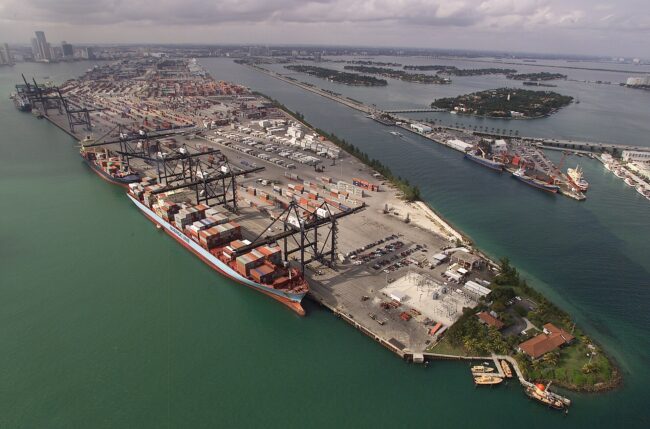
Aerial view of the PortMiami container terminal. Source: U.S. Customs and Border Protection (James R. Tourtellotte) via Wikimedia Commons / License: Public domain (U.S. federal government work)
Quick Answer: Goods trade through the Miami Customs District, which covers Miami-Dade, Broward and Palm Beach counties, reached $84.5 billion in exports and $64.0 billion in imports in 2025, a $20.5 billion surplus, according to World Trade Center Miami’s analysis of U.S. Census Bureau data. Statewide, Florida’s seaports and airports handled $205 billion in merchandise trade in 2025. Brazil remains the region’s dominant partner, and Florida-Brazil trade grew 7.3% in 2025 even after a 50% U.S. tariff on many Brazilian goods took effect in August of that year.
South Florida’s economy is often described through tourism and real estate, but the region also runs one of the largest goods-trade gateways in the United States. The numbers for 2025 and early 2026 show a district that exports far more than it imports, leans heavily on Latin America, and has been working through an unusually volatile run of U.S. tariff policy.
What are the key South Florida trade numbers?
| Measure | Value | Period |
|---|---|---|
| Miami Customs District exports | $84.5 billion | 2025 |
| Miami Customs District imports | $64.0 billion | 2025 |
| Miami Customs District trade surplus | $20.5 billion | 2025 |
| Re-exports of foreign goods through Miami | $25.0 billion | 2025 |
| Florida merchandise trade, all seaports and airports | $205 billion (+4.2%) | 2025 |
| Florida-origin goods exports | $78.9 billion (+8.9%) | 2025 |
| Florida-Brazil merchandise trade | $27.5 billion (+7.3%) | 2025 |
| PortMiami container volume | 1,115,058 TEUs (+2.35%) | FY2025 (Oct. 2024 to Sept. 2025) |
Source: World Trade Center Miami analysis of U.S. Census Bureau data; SelectFlorida; Miami-Dade County / PortMiami.
How much trade moved through the Miami Customs District in 2025?
The Miami Customs District is the federal statistical unit for the ports of entry in Miami-Dade, Broward and Palm Beach counties. It includes PortMiami, Miami International Airport (MIA), Port Everglades, the Port of Palm Beach and smaller entry points.
In 2025 the district exported $84.5 billion in goods and imported $64.0 billion, according to an analysis of U.S. Census Bureau and USA Trade Online data by Alice Ancona, chief operating officer of World Trade Center Miami. Together those flows total $148.5 billion. The result was a $20.5 billion trade surplus, which the analysis says has kept widening in 2026.
Global Miami magazine’s State of Trade 2025 report put the district’s 2024 total at $144 billion, with $78 billion in exports and $66 billion in imports. The two reports come from different publishers, but on those figures exports rose by about $6.5 billion from 2024 to 2025 while imports slipped by about $2 billion.
Why does Miami run a surplus when Florida runs a deficit?
The World Trade Center Miami analysis says Florida as a whole ran a $36.8 billion deficit over the same period. Vehicles, organic chemicals, and electronics and pharmaceuticals from Asia and Europe drove that deficit, mostly entering through the state’s other ports.
The South Florida surplus is concentrated in aerospace, machinery and pharmaceuticals shipped to Latin America. Another $25.0 billion in foreign-made goods was re-exported through Miami’s ports, airport and free trade zones. That re-export business grew faster than exports of U.S.-made goods, which points to the region’s role as a distribution hub for the Americas.
How big is Florida’s overall trade?
SelectFlorida, the state’s trade development organization formerly known as Enterprise Florida, reported on April 1, 2026, that bilateral merchandise trade through Florida’s seaports and airports reached $205 billion in 2025. That was up $8.3 billion, or 4.2%, from 2024 and up 33.3% from 2018. Florida businesses also exported a record $78.9 billion in Florida-origin goods in 2025, up 8.9%. Manufactured products made up 92% of that total.
Who are South Florida’s top trading partners?
Brazil leads by a wide margin. Global Miami’s 2024 data showed the Miami district traded $19.38 billion with Brazil, including $15.3 billion in exports. Colombia was second at $10.03 billion, followed by the Dominican Republic, China and Chile. World Trade Center Miami’s 2025 analysis describes Brazil as Miami’s largest trading partner in nearly every category.
SelectFlorida’s country profiles show that statewide trade with Brazil kept growing in 2025, alongside other South American partners such as Argentina.
| Florida trade with | 2024 | 2025 | Change |
|---|---|---|---|
| Brazil, total trade | $25.60B | $27.48B | +7.3% |
| Brazil, exports | $18.52B | $19.95B | +7.7% |
| Brazil, imports | $7.08B | $7.53B | +6.4% |
| Argentina, total trade | $4.84B | $5.38B | +11.2% |
| Argentina, exports | $3.79B | $4.30B | +13.2% |
Source: SelectFlorida, Brazil and Argentina Florida Merchandise Trade Profiles (WISERTrade, U.S. Census Bureau data). Florida seaports and airports, nominal dollars.
Florida’s top export markets in 2025 were Brazil, Mexico, Canada, Germany and Colombia, according to SelectFlorida. In the latest full-year statewide partner ranking SelectFlorida has published, for 2024, Latin America and the Caribbean made up more than half of Florida’s bilateral trade and more than three-quarters of its exports. That ranking listed Brazil ($25.67 billion), Chile ($10.90 billion), China ($10.69 billion), Colombia ($10.35 billion) and Mexico ($9.35 billion) as the top five partners.
Which partners are gaining ground?
World Trade Center Miami reports that Costa Rica moved into the Miami district’s top 10 export markets, with growth in imports and re-exports as well. The country’s medical-device cluster drives much of that trade. The analysis also notes that Intel’s closure of its Costa Rica assembly plant, announced in mid-2025, showed up in Miami’s trade numbers.
What goods dominate South Florida trade?
Aerospace leads both the export and import sides. SelectFlorida’s top Florida-made export categories for 2025 were:
| Rank | Florida-made export category | 2025 value |
|---|---|---|
| 1 | Civilian aircraft and parts | $12.8 billion |
| 2 | Telephones | $5.7 billion |
| 3 | Pharmaceuticals | $3.6 billion |
| 4 | Turbojets and gas turbines | $2.4 billion |
| 5 | Cars | $2.4 billion |
Source: SelectFlorida, Florida Businesses Set Record-High Export Sales in 2025 (April 1, 2026).
The Miami district’s aerospace trade has an unusual profile. Roughly two-thirds of U.S. jet-engine exports are parts. In Miami, nearly 60% of engine exports are whole, finished engines, and on the import side the share is 72%, more than double the national rate. Engine imports come mainly from the United Kingdom, France, Canada and Germany.
On the import side, Global Miami’s 2024 district data listed telephones ($4.23 billion), gold ($3.73 billion), fish fillets ($2.38 billion), cut flowers ($1.88 billion) and recreational boats ($1.65 billion) as leading products. In 2026, World Trade Center Miami reports that AI-related computer hardware imports from Taiwan into Miami were up more than 40% year to date.
How is trade split among PortMiami, MIA and Port Everglades?
Port-level dollar values are published less consistently than district totals, and the most recent comparable set is for 2024. Global Miami’s State of Trade 2025 report gave these values:
| Gateway | 2024 trade value | Profile |
|---|---|---|
| Miami International Airport | $82.33 billion | More than 3 million tons of cargo |
| PortMiami | $30.4 billion | About 46% Latin America/Caribbean, 33% Asia, 20% Europe/Mediterranean |
| Port Everglades | $27.9 billion | About 90% of commerce with Latin America/Caribbean; 52% exports, 48% imports |
Source: Global Miami magazine, The State of Trade 2025 and State of the Ports 2025.
By value, the airport carries the largest share because high-value, low-weight goods such as phones, pharmaceuticals, aircraft parts and gold move by air. MIA’s cargo operations have been covered in depth elsewhere. For this report, the key point is that MIA’s $82.33 billion was more than half of the district’s $144 billion total in 2024.
What did PortMiami’s latest fiscal year show?
PortMiami handled 1,115,058 TEUs (twenty-foot equivalent units) in fiscal 2025, which ran from October 1, 2024, to September 30, 2025. That was up 2.35% from 1,089,443 the year before, according to a December 2, 2025, Miami-Dade County release. The county’s proposed FY2026-27 seaport budget sets more conservative cargo targets: 1,080,000 TEUs for FY2025-26 and 1,020,000 TEUs for FY2026-27. It also budgets a cargo incentive program of up to $15 million.
PortMiami’s Latin America and Caribbean statistics for FY2025 show where its regional container trade goes. The Dominican Republic was the top partner by container volume in both directions, with 40,394 import TEUs and 35,620 export TEUs. Honduras, Colombia, Guatemala and Ecuador followed on imports. Honduras, Guatemala and Jamaica followed on exports. By volume, fruits and vegetables led the commodity list at 97,366 TEUs, followed by apparel and textiles at 67,506 TEUs and machinery at 38,770 TEUs.
How did tariffs and trade policy affect South Florida trade in 2025 and 2026?
Because Brazil is the region’s largest partner, U.S. actions against Brazil matter more in South Florida than almost anywhere else. The main federal actions since mid-2025:
| Date | Action |
|---|---|
| July 30, 2025 | Executive order adds a 40% tariff on Brazilian goods, for a 50% total; effective Aug. 6, 2025. Civil aircraft, orange juice, some energy products and other Annex I goods excluded. |
| Nov. 20, 2025 | Order removes the extra 40% on more than 200 Brazilian agricultural tariff lines, retroactive to Nov. 13, 2025. |
| Feb. 20, 2026 | U.S. Supreme Court rules in Learning Resources v. Trump that IEEPA does not authorize tariffs, invalidating “reciprocal” and related duties. |
| Feb. 24, 2026 | 10% Section 122 tariff on most imports takes effect for 150 days. |
| July 22, 2026 | Additional 25% Section 301 tariff on most Brazilian products; civil aircraft, engines and parts excluded. |
| July 24, 2026 | Section 122 tariffs expire; new Section 301 tariffs of 10% or 12.5% apply to about 60 countries. |
Source: The White House; Sandler, Travis & Rosenberg; DLA Piper; Clark Hill; Z2Data; American Association of Customs Brokers.
Did the Brazil tariffs cut Florida’s Brazil trade?
Not in the 2025 annual totals. Florida’s imports from Brazil rose 6.4% to $7.53 billion in 2025, even though the 50% rate applied for nearly five months of the year. The largest Brazilian import category, powered aircraft and spacecraft, grew 24.4% to $1.87 billion. Civil aircraft were on the exclusion list, which is relevant here, though the profile data alone cannot show how much of the growth came from that exclusion.
Florida’s exports to Brazil, which do not face U.S. tariffs, rose 7.7% to $19.95 billion. The top export to Brazil, civilian aircraft, engines and parts, slipped 0.8% to $6.18 billion.
The legal footing for tariffs changed in 2026. The Supreme Court’s February ruling removed the emergency-powers basis for the 2025 Brazil duty and the reciprocal tariffs. Importers that paid those duties may be entitled to refunds, but the court did not spell out how refunds would work. In July 2026, Brazil became subject to a separate 25% Section 301 tariff. That action followed a U.S. Trade Representative investigation started July 15, 2025, covering digital trade, ethanol market access, intellectual property and deforestation, among other issues. The Section 301 tariff again excludes civil aircraft and parts, South Florida’s largest export category.
What happened to food tariffs?
A December 2025 presentation to World Trade Center Miami by Miami-based Americas Market Intelligence described late-2025 rollbacks of some of the steepest food tariffs on Latin American exports, which it tied to grocery-price pressure. Perishables matter for this region. Global Miami reports that MIA handles nearly 70% of U.S. perishable imports. PortMiami’s top Latin American container commodity is fruits and vegetables.
What does 2026 data show so far?
Full-year 2026 district totals will not be available until early 2027, and published year-to-date figures for the district as a whole are limited. The verifiable signals so far:
- World Trade Center Miami says the district’s trade surplus has continued to widen through 2026.
- Imports of AI hardware from Taiwan into Miami were up more than 40% year to date in its 2026 analysis.
- U.S. exports to Cuba hit $202.5 million in August 2026, the highest monthly total since 1992, based on Census figures reported by CiberCuba. The Miami district accounted for about $49.6 million in fuel exports that month, according to the U.S.-Cuba Trade and Economic Council.
- Miami-Dade’s budget documents plan for PortMiami container volume to come in below the FY2025 record in FY2025-26 and FY2026-27.
Frequently Asked Questions
What is the Miami Customs District?
It is the U.S. Census Bureau and Customs statistical district covering ports of entry in Miami-Dade, Broward and Palm Beach counties, including PortMiami, MIA, Port Everglades and the Port of Palm Beach.
How much trade did the Miami Customs District handle in 2025?
Exports were $84.5 billion and imports were $64.0 billion, for a combined $148.5 billion and a $20.5 billion surplus, according to World Trade Center Miami’s analysis of Census data.
Who is South Florida’s largest trading partner?
Brazil. Florida-Brazil trade reached $27.48 billion in 2025, up 7.3%. In 2024, the Miami district traded $19.38 billion with Brazil.
What is South Florida’s biggest export?
Aircraft and aerospace products. Civilian aircraft and parts were Florida’s top made-in-Florida export in 2025 at $12.8 billion.
Are U.S. tariffs on Brazil still in effect?
The 2025 emergency-powers tariff was invalidated by the Supreme Court in February 2026. A separate 25% Section 301 tariff on most Brazilian products took effect July 22, 2026, with civil aircraft and parts excluded.
Sources and Further Reading
- Miami’s Trade Data Tells a Different Story Than Florida’s or even the Nation’s — World Trade Center Miami
- Florida Businesses Set Record-High Export Sales in 2025 — SelectFlorida
- Brazil Florida Merchandise Trade Profile — SelectFlorida
- Argentina Florida Merchandise Trade Profile — SelectFlorida
- Annual Florida Merchandise Trade Summary and Top 50 Rankings, 2024 — SelectFlorida
- Perspectives on the Miami Customs District, Today and Tomorrow (The State of Trade 2025) — Global Miami magazine
- PortMiami Fiscal Year 2025 Cargo and Cruise Results (news release) — Miami-Dade County
- Latin America and the Caribbean Statistics 2025 — PortMiami
- FY2026-27 Proposed Budget, Seaport — Miami-Dade County
- Fact Sheet: President Donald J. Trump Addresses Threats to the United States from the Government of Brazil — The White House
- White House Executive Order Increases Tariffs on Brazilian Imports to 50% — American Association of Customs Brokers
- U.S. Rolls Back Higher Tariffs on Agricultural Imports from Brazil — Sandler, Travis & Rosenberg
- U.S. Supreme Court Holds IEEPA Does Not Authorize Tariffs — DLA Piper
- USTR Imposes 25% Section 301 Tariff on Imports from Brazil — Clark Hill
- How the Termination of Section 122 Tariffs Impacts Your Supply Chain — Z2Data
- Tariffs, Trade Disruptions and the Future Cast for Latin America — Americas Market Intelligence / World Trade Center Miami
- U.S. Exports to Cuba Exceed $200 Million in August — CiberCuba
About Brian French
Led by a commitment to tech-intelligent curation, Brian French tracks and analyzes the Business News in South Florida including corporate developments defining Florida's economy. Brian brings an extensive financial background to his analysis, having graduated from the University of South Florida in Finance and serving as a Vice President and Portfolio Manager for Merrill Lynch Private Investors and the Trust Department in St. Petersburg, FL, as well as a Vice President and Trust Investment Officer for SunTrust Bank in Sarasota, FL. His writing blends macroeconomic trends, capital markets, corporate strategy, and modern digital insights for a sophisticated look at Florida's dynamic business economy.