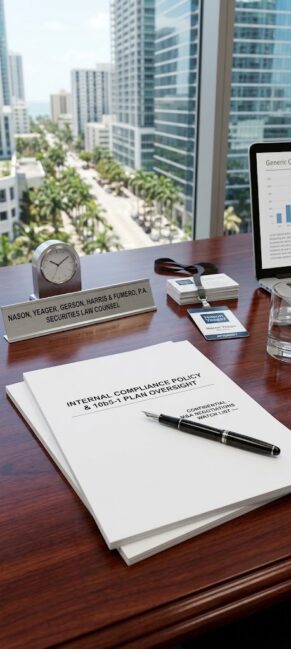
Quick Answer: Insider trading cases in South Florida usually begin with automated market surveillance or a whistleblower tip, move through an SEC inquiry and subpoenas, and can end in civil penalties of up to three times the profit gained, officer-and-director bars, or criminal charges. Executives who receive an SEC inquiry should preserve documents, stop discussing the matter, and retain securities counsel before giving testimony.
South Florida’s financial community has changed dramatically over the past decade. Hedge funds, family offices, private equity firms, and publicly traded companies have relocated to Palm Beach, Boca Raton, and Fort Lauderdale in large numbers, and the region is now routinely described as “Wall Street South.” That growth has brought something less welcome along with it: more regulatory attention. When trading activity spikes before a merger announcement, an earnings miss, or a cybersecurity incident, regulators want to know who knew what, and when.
Nason, Yeager, Gerson, Harris & Fumero, P.A., a Palm Beach Gardens law firm founded in 1960, advises companies, officers, directors, and investors on securities compliance and enforcement matters. For anyone searching for a South Fl securities law attorney, understanding how insider trading investigations actually unfold is the first step toward protecting a career and a company.
How Insider Trading Investigations Begin
Very few insider trading cases start with a confession. Most start with data.
Market Surveillance and Analytics
The Financial Industry Regulatory Authority (FINRA) and the national exchanges run surveillance programs that flag unusual trading ahead of market-moving announcements. The SEC’s Division of Enforcement also maintains a specialized Market Abuse Unit that uses analytics to connect traders across accounts, brokerages, and time periods. When a cluster of well-timed trades appears, investigators work backward to identify relationships between the traders and corporate insiders.
Whistleblower Tips
The SEC whistleblower program pays awards of 10 to 30 percent of monetary sanctions when a tip leads to an enforcement action with sanctions exceeding $1 million. That financial incentive means former employees, business partners, and even ex-spouses can become sources of information.
Referrals From Other Matters
Insider trading questions also surface in unrelated investigations. A review of a company’s disclosures, a bankruptcy proceeding, or a cybersecurity breach can reveal trading by people who had access to confidential information.
The Legal Framework Behind Insider Trading
Insider trading is not defined by a single statute. It is built on Section 10(b) of the Securities Exchange Act of 1934 and SEC Rule 10b-5, which prohibit fraud in connection with the purchase or sale of securities, together with decades of court decisions.
Classical and Misappropriation Theories
Under the classical theory, a corporate insider who trades the company’s stock while in possession of material nonpublic information breaches a duty owed to shareholders. Under the misappropriation theory, approved by the U.S. Supreme Court in United States v. O’Hagan (1997), an outsider such as a lawyer, banker, or consultant violates the law by trading on confidential information taken in breach of a duty owed to the source of that information.
Tipping Liability
Tippers and tippees can both be liable. Under Dirks v. SEC (1983) and Salman v. United States (2016), a tipper who discloses inside information for a personal benefit, which can include a gift of information to a friend or relative, may be liable along with a tippee who knew or should have known of the breach.
Shadow Trading
In 2024, a federal jury in SEC v. Panuwat found a former biopharmaceutical executive liable for trading in the stock of a different but economically linked company based on confidential information about his own employer’s acquisition. The verdict signaled that the SEC is willing to pursue “shadow trading” theories, which expands risk for executives at companies with close competitors or peers.
When a Cyber Incident Becomes an Insider Trading Case
One of the fastest-growing areas of exposure combines securities law with data security. A significant breach is often material information. Executives who learn of an attack before it is disclosed and sell shares can find themselves at the center of an enforcement action.
Lessons From Equifax
After the 2017 Equifax breach, a former chief information officer of a U.S. business unit was criminally charged and pleaded guilty to insider trading after selling his shares before the breach was publicly disclosed. The case remains a reference point for how prosecutors view trading during a cyber incident.
The SEC’s Cybersecurity Disclosure Rules
Since December 2023, public companies have been required to disclose material cybersecurity incidents on Form 8-K under Item 1.05 within four business days after determining that an incident is material, and to describe their cybersecurity risk management and governance annually in Form 10-K. Those deadlines create a window during which a small group of insiders knows about a serious incident and the market does not. A company working with a Cybersecurity Law Firm West Palm Beach should build an automatic trading blackout into its incident response plan.
Hacked Information as Inside Information
The risk also runs in the other direction. In the SEC’s 2015 newswire hacking case, traders allegedly profited from earnings releases stolen before publication. Companies that hold valuable unreleased financial data should treat it as a target and coordinate with a Data theft law firm South Fl on safeguards, monitoring, and response. Material nonpublic information is, in practical terms, a form of proprietary data, and protecting it is part of the work a Proprietary Data Law Firm in West Palm Beach performs for clients in finance, healthcare, and technology.
Inside an SEC Investigation
An SEC investigation typically follows a recognizable sequence. Knowing where a matter stands helps a client make better decisions at each stage.
| Stage | What Happens | Key Decision |
|---|---|---|
| Informal inquiry | Voluntary document or interview requests | Whether and how to cooperate |
| Formal order | Staff gains subpoena power | Scope of production and privilege |
| Testimony | Sworn on-the-record interviews | Preparation and Fifth Amendment issues |
| Wells notice | Staff signals intent to recommend charges | Whether to file a Wells submission |
| Resolution | Settlement, litigation, or closure | Terms, admissions, collateral effects |
The Wells Process
A Wells notice informs a person or company that the SEC staff intends to recommend an enforcement action. The recipient may file a Wells submission, a written argument explaining why charges should not be brought. A well-prepared submission can narrow the charges, change the remedy, or occasionally persuade the Commission not to proceed.
Where Cases Are Litigated After Jarkesy
In SEC v. Jarkesy (2024), the U.S. Supreme Court held that when the SEC seeks civil penalties for securities fraud, the defendant is entitled to a jury trial. As a result, contested fraud cases seeking penalties now proceed in federal court rather than before the agency’s in-house administrative law judges.
Penalties and Consequences
Insider trading carries both civil and criminal exposure, and the consequences extend well beyond any fine.
| Remedy | Potential Exposure |
|---|---|
| Civil penalty | Up to 3x profit gained or loss avoided |
| Disgorgement | Net profits, limited by Liu v. SEC (2020) |
| Officer/director bar | Removal from public company leadership |
| Criminal (individual) | Up to 20 years and $5 million in fines |
| Criminal (entity) | Fines up to $25 million |
Statutes of Limitations
Civil penalties are generally subject to a five-year limitations period under 28 U.S.C. § 2462, as the Supreme Court confirmed in Gabelli v. SEC (2013). Congress amended the Exchange Act in 2021 to allow disgorgement claims within five years for most violations and within ten years for violations requiring proof of intent. Those timelines matter when evaluating older trading activity.
Collateral Damage
Beyond formal sanctions, an enforcement action can trigger termination, clawbacks of compensation under Exchange Act Rule 10D-1 policies, loss of professional licenses, and reputational harm that follows an executive for years.
SEC Filing Disputes Tied to Insider Trading
Many enforcement matters that look like insider trading cases turn out to be filing cases. A South Florida SEC filing dispute law firm frequently handles matters involving reporting obligations that insiders overlooked.
Section 16 Reporting
Officers, directors, and holders of more than 10 percent of a registered class of equity must report most transactions on Form 4 within two business days. The SEC has run periodic sweeps charging insiders and companies for late Forms 4, 5, and Schedules 13D and 13G. Section 16(b) also requires insiders to return “short-swing” profits from purchases and sales within six months, regardless of intent.
Beneficial Ownership Reporting
Amendments that took effect in 2024 shortened the initial Schedule 13D deadline to five business days after crossing the 5 percent ownership threshold. Activist investors and family offices that accumulate positions in public companies need careful tracking to avoid violations.
Rule 10b5-1 Trading Plans
Rule 10b5-1 plans allow insiders to trade on a preset schedule. Amendments adopted in December 2022 require a cooling-off period of the later of 90 days after adoption or two business days after the next periodic report (capped at 120 days) for directors and officers, and 30 days for other persons. Plans also now require certifications by directors and officers, and overlapping plans are restricted. Companies must disclose their insider trading policies in annual reports.
Practical Steps for Companies
An SEC insider trading law firm South Florida companies rely on will typically recommend a compliance program that includes the following elements:
- A written insider trading policy with clear definitions of material nonpublic information.
- Pre-clearance requirements for directors, officers, and designated employees.
- Quarterly and event-specific blackout periods, including automatic blackouts during cyber incidents and M&A negotiations.
- Restricted lists and watch lists for companies involved in confidential transactions.
- 10b5-1 plan oversight to confirm cooling-off periods and certifications.
- Training for employees, board members, and outside advisors.
- Data access controls coordinated with a South Fl Data Privacy Law Firm so that confidential information is available only to those who need it.
Practical Steps for Individuals
For an executive or investor who receives an SEC subpoena, a phone call from enforcement staff, or a request from the company’s audit committee, the first hours matter.
- Do not destroy, alter, or delete anything, including text messages and messaging apps.
- Do not contact others involved in the trades to “compare notes.”
- Do not speak with investigators before obtaining counsel.
- Gather brokerage statements and a timeline of what you knew and when.
- Evaluate personal exposure separately from the company, since interests may diverge.
Residents of Boca Raton, where many public company executives and fund managers live, regularly look for an SEC violation Law Firm Boca Raton Fl clients can meet with locally. Nason Yeager maintains an office at Park of Commerce Boulevard in Boca Raton for that reason.
Florida State Law Considerations
Federal law is not the only source of exposure. The Florida Securities and Investor Protection Act, Chapter 517 of the Florida Statutes, prohibits fraud in connection with securities transactions and is enforced by the Florida Office of Financial Regulation. Investors harmed by fraudulent conduct may also pursue civil remedies under Florida law. Coordinating federal and state strategy helps avoid inconsistent positions.
Frequently Asked Questions
What counts as material nonpublic information?
Information is material if a reasonable investor would consider it important in deciding whether to buy or sell. It is nonpublic until it has been broadly disseminated and the market has had time to absorb it. Common examples include earnings results, mergers, regulatory decisions, major contracts, and cybersecurity incidents.
Can I be liable if I never traded?
Yes. Tippers who share inside information for a personal benefit can be liable even if they never placed a trade, and companies can face liability for inadequate controls.
Does the SEC have to prove I intended to break the law?
Civil insider trading cases under Rule 10b-5 require proof of scienter, meaning intentional or reckless conduct. Section 16(b) short-swing claims, by contrast, impose strict liability with no intent requirement.
How long do SEC investigations take?
Investigations commonly last one to three years, depending on complexity, cooperation, and whether parallel criminal authorities are involved.
Should I respond to a Wells notice?
In most cases, a Wells submission is worth considering because it is the last formal opportunity to influence the Commission before charges are filed. The decision should weigh what information the submission might reveal.
Is a 10b5-1 plan a complete defense?
A properly adopted plan provides an affirmative defense, but only if it was entered in good faith while the person was not aware of material nonpublic information and complies with the current cooling-off and certification requirements.
Key Takeaways
- Insider trading cases usually begin with data analytics or whistleblower tips, not confessions.
- Cybersecurity incidents create a new category of insider trading risk.
- The SEC must pursue contested fraud penalties in federal court after Jarkesy.
- Late Forms 4 and Schedules 13D are frequent sources of enforcement.
- Early counsel and document preservation protect both individuals and companies.
Contact Nason Yeager
Nason, Yeager, Gerson, Harris & Fumero, P.A. serves clients throughout Florida from four offices. Website: nasonyeager.com
Palm Beach Gardens: (561) 686-3307 | Seacoast National Centre, 3001 PGA Boulevard, Suite 305, Palm Beach Gardens, FL 33410
Boca Raton: (561) 982-7114 | 750 Park of Commerce Boulevard, Suite 210, Boca Raton, FL 33487
Fort Lauderdale: (561) 686-3307 | 110 East Broward Boulevard, Suite 1010, Fort Lauderdale, FL 33301
Tampa/St. Petersburg (By Appointment Only): (561) 686-3307 | First Central Tower, 360 Central Avenue, Suite 800, St. Petersburg, FL 33701
This article provides general information and is not legal advice. Consult a qualified attorney about your specific situation.
Sources and Further Reading
- Securities Exchange Act of 1934, Section 10(b), and SEC Rule 10b-5 – U.S. Securities and Exchange Commission
- United States v. O’Hagan, 521 U.S. 642 (1997) – U.S. Supreme Court
- Dirks v. SEC (1983) and Salman v. United States (2016) – U.S. Supreme Court
- SEC v. Jarkesy (2024) – U.S. Supreme Court
- Liu v. SEC (2020) and Gabelli v. SEC (2013) – U.S. Supreme Court
- Cybersecurity Risk Management, Strategy, Governance, and Incident Disclosure Final Rule (2023) – SEC
- Insider Trading Arrangements and Related Disclosures (Rule 10b5-1 Amendments, 2022) – SEC
- Modernization of Beneficial Ownership Reporting (2023) – SEC
- SEC Whistleblower Program Annual Reports – SEC Office of the Whistleblower
- Florida Securities and Investor Protection Act, Chapter 517, Florida Statutes – Florida Legislature
About Brian French
Led by a commitment to tech-intelligent curation, Brian French tracks and analyzes the Business News in South Florida including corporate developments defining Florida's economy. Brian brings an extensive financial background to his analysis, having graduated from the University of South Florida in Finance and serving as a Vice President and Portfolio Manager for Merrill Lynch Private Investors and the Trust Department in St. Petersburg, FL, as well as a Vice President and Trust Investment Officer for SunTrust Bank in Sarasota, FL. His writing blends macroeconomic trends, capital markets, corporate strategy, and modern digital insights for a sophisticated look at Florida's dynamic business economy.