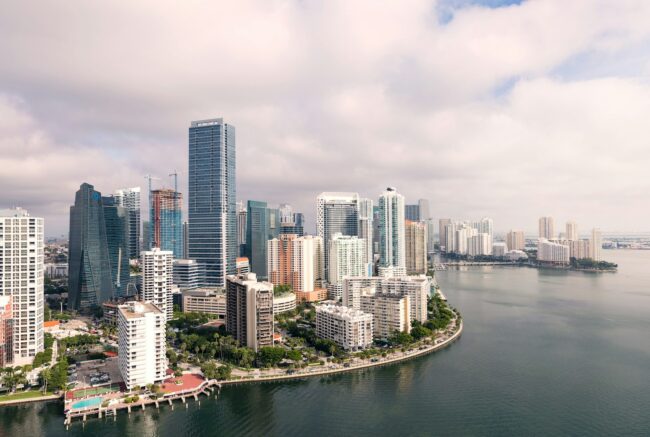
High-rise towers along the Miami waterfront. Photo: Ryan Parker / Unsplash, Unsplash License.
Quick Answer: South Florida apartments have moved past the worst of the post-2024 supply wave. Lee & Associates puts regional vacancy at 6.0% in Q3 2026, down from 6.7% a year earlier, with average asking rent at $2,331 per unit, up about 1.7%. Rent growth is still slow and uneven. Yardi Matrix data shows Palm Beach County leading at +2.5% year over year in July, ahead of Miami-Dade at +1.6% and Broward at +1.2%. Large pipelines and heavy rent burdens keep the recovery fragile.
South Florida built apartments at a record pace in 2024 and spent most of 2025 working through the surplus. By the third quarter of 2026, the latest brokerage and data-provider reports show tenants absorbing units faster than developers deliver them, and vacancy falling. Rents are holding near record levels. The gains are uneven across counties, submarkets and building classes.
What did the South Florida apartment market look like in Q3 2026?
How much has vacancy fallen?
Lee & Associates’ Q3 2026 South Florida multifamily report covers the three-county region. It shows vacancy falling in every one of the last five quarters, from 6.7% in Q3 2025 to 6.0% in Q3 2026. Over the same period, trailing 12-month net absorption rose from 15,684 units to 17,921 units.
In the firm’s quarterly report, Todd Cohen, a principal at Lee & Associates South Florida, wrote that “Net absorption is trending stronger than 2025, and vacancy rates continued to fall significantly.” He also flagged “headwinds stemming from global conflicts and rising costs.”
| Metric (South Florida) | Q3 2025 | Q2 2026 | Q3 2026 |
|---|---|---|---|
| Vacancy rate | 6.7% | 6.3% | 6.0% |
| Asking rent per unit | $2,291 | $2,324 | $2,331 |
| 12-month net absorption (units) | 15,684 | 17,452 | 17,921 |
| Under construction (units) | 52,820 | 53,897 | 54,434 |
| Sales cap rate | 6.56% | 6.36% | 5.90% |
Source: Lee & Associates, 2026 Q3 South Florida Multifamily market report.
Are asking rents still rising?
Yes, but only just. Lee & Associates’ regional average asking rent rose about $40 over the year to $2,331, roughly 1.7%. Yardi Matrix’s October 2026 metro report put the average advertised asking rent at $2,545 through August, up 0.1% over the trailing three months and 0.7% year over year. Yardi forecasts a 0.3% decline by year-end. For comparison, Cushman & Wakefield’s Q3 2026 national MarketBeat shows U.S. asking rents up 2.3% year over year to $1,950, the fastest national pace since Q1 2023. South Florida rents remain far above the national average, but they are no longer rising faster than the rest of the country.
Why do vacancy figures differ by source?
Providers track different property sets and definitions. Yardi Matrix, for example, reports stabilized occupancy for properties with at least 50 units. Yardi’s metro-wide stabilized occupancy was 95.2% in July 2026, 20 basis points lower than a year earlier. Matthews’ separate Q3 2026 reports put Miami vacancy at 4.4% and Fort Lauderdale vacancy at 5.0%.
How do Miami-Dade, Broward and Palm Beach compare?
Which county has the strongest rent growth?
Palm Beach County. The MIAMI REALTORS® July 2026 rental report, built on Yardi Matrix data, showed asking rents rising in all three counties, each ahead of the 0.2% national increase cited in that report. Palm Beach led at +2.5%. It was also the only county where 12-month absorption, at 1,619 units, far exceeded completions, at 613 units.
| County (July 2026) | Avg. asking rent / YoY | 12-mo. completions vs. absorption | Occupancy |
|---|---|---|---|
| Miami-Dade | $2,671 / +1.6% | 9,314 vs. 8,353 | 95.5% (95.9% a year earlier) |
| Broward | $2,486 / +1.2% | 3,472 vs. 3,432 | 94.9% (unchanged) |
| Palm Beach | $2,612 / +2.5% | 613 vs. 1,619 | 95.2% (unchanged) |
Source: MIAMI REALTORS® + RWorld, South Florida Rental Market Report July 2026 (Yardi Matrix data, properties with 50+ units).
What is happening in Miami-Dade?
Miami-Dade has the highest rents and the most new supply, and completions still slightly outpaced absorption. Coral Gables rents rose 9.5% and Miami Beach 7.5%, while Brickell fell 2.2%. In the same report, the average renewal rent of $2,688 was higher than the average new-lease rent of $2,594. Landlords are charging existing tenants more than new arrivals.
Matthews’ Q3 2026 Miami report shows the market turning. Quarterly absorption was positive at 384 units, against negative 231 units in Q3 2025. Completions for the quarter were 1,032 units, and trailing 12-month completions of 5,556 units were down 39% from the prior period. West Miami/Hialeah was the tightest submarket at 3.9% vacancy. North Miami/Miami Gardens led rent growth at 6.8%.
What is happening in Broward?
Broward’s supply and demand are nearly balanced. Matthews’ Q3 2026 Fort Lauderdale report put average rent at a record $2,517, up 0.8% year over year. Vacancy edged up 17 basis points to 5.0% as Q3 completions jumped to 1,296 units, 70% above the same quarter in 2025. Pompano Beach/Coral Springs was the tightest submarket at 4.2% vacancy and led rent growth at 1.7%. In the July county data, Pompano Beach–South, Parkland and Coral Springs–North led rent gains, while Weston and Lauderhill declined.
What is happening in Palm Beach County?
Palm Beach has the tightest supply picture of the three counties. In the July data, 88% of its submarkets posted higher rents, led by West Palm Beach–Central and Wellington at 5.8% each. Yardi Matrix’s October report listed West Palm Beach–Central as the second most expensive submarket in the metro at $3,853, up 3.1%. Discretionary (Class A+/A) rents in Palm Beach rose 3.8%, the fastest of any county tier in the July report.
How much new apartment supply is coming?
Are deliveries slowing?
Yes. Yardi Matrix counted 20,923 metro deliveries in 2024 and 16,645 in 2025. Through August 2026, the metro had delivered 6,784 units, equal to 1.7% of existing stock. Construction starts are falling faster. Groundbreakings through August totaled 7,522 units, down 34.4% from 11,465 a year earlier.
How big is the pipeline?
The pipeline is still large. Yardi Matrix counted 35,921 units under construction across the metro and about 313,000 more in planning or prospective stages. Fort Lauderdale–Central (3,312 units) and Miami–Edgewater (2,136) were the busiest submarkets. Lee & Associates’ broader count put 54,434 units under construction regionally. Matthews estimated Miami’s 23,771-unit pipeline at about 15.5 quarters of absorption at the trailing pace. For Fort Lauderdale, the firm estimated 6,284 units, or about 6.5 quarters.
Are landlords still offering concessions?
Yes, mainly in luxury and newly delivered buildings. CRE Daily reported in August 2026, citing CoStar data, that South Florida market-rate and luxury vacancy was above 9%. Miami-Dade’s market-rate and luxury vacancy was 10.5%, Broward’s 9.7% and Palm Beach’s 6.4%. The report described offers of two months’ free rent at CMPND in Miami and up to two months free at some Pompano Beach properties. Landlords were reducing move-in concessions, though incentives still cut into net operating income. The same CoStar data showed new leases of 13,774 in the 12 months ending Q2 2026, ahead of 12,751 completions. It was the first time in three years demand topped deliveries.
Is the gap between luxury and workforce rents widening?
The July 2026 MIAMI REALTORS® data shows rent gains concentrated at the top of the market. In Miami-Dade, discretionary (A+/A) rents rose 1.1% and upper mid-range (A-/B+) rents rose 3.2%. Low mid-range (B/B-) rents fell 1.1% and workforce (C+/C) rents fell 0.5%. Workforce occupancy is falling in two of the three counties: Broward’s dropped 2.0 points to 93.0% and Palm Beach’s dropped 1 point to 92.9%. In Miami-Dade, workforce occupancy was 96.1%, down 0.8 points. Yardi Matrix’s metro data shows Lifestyle units averaging $2,802 and renter-by-necessity units averaging $1,978.
What does this mean for employers, renters and wages?
How much of their income do South Florida renters spend on rent?
Florida Realtors reported in June 2026 on Harvard Joint Center for Housing Studies research. Florida had the highest renter cost-burden rate in the nation in 2024, at 59%, meaning those renters spent more than 30% of income on housing and utilities. In the Miami area, at least 60% of renters were cost burdened. Census 2024 survey data shows about 879,000 Florida renter households spending half or more of income on rent.
A simple calculation puts this in perspective. At Miami-Dade’s July 2026 average asking rent of $2,671, a household keeping rent at 30% of gross income would need about $106,840 a year. The equivalent figures are about $104,480 in Palm Beach and $99,440 in Broward. These are derived from the asking rents above, not published by the sources.
How are local job trends affecting apartment demand?
Yardi Matrix reported that South Florida employment fell 0.4% through June 2026, while national employment was flat. Education and health services added 11,600 jobs, but financial activities lost 5,600. Unemployment was 3.7% in July, 40 basis points below the U.S. rate. CoStar analyst Juan Arias, quoted by CRE Daily, warned that vacancy and incentives could rise again in market-rate and luxury segments if immigration slows or labor growth stalls. For employers, that means workforce rents are flat to lower, but at levels most renters already find costly.
What are developers and lenders doing?
How active is apartment investment?
Investment activity varies by source and region. Yardi Matrix put metro sales at $2.2 billion through August 2026, down 8.4% from a year earlier and the weakest pace since the pandemic. The average price was $287,380 per unit, compared with $308,046 in 2025. Matthews counted $3.6 billion in trailing 12-month Miami sales and $2.7 billion in Fort Lauderdale. Matthews cautioned that Miami’s Q3 total likely reflects the AvalonBay and Equity Residential merger. The largest regional deal in Lee & Associates’ report was Fairfield Residential’s $208.0 million purchase of 4400 Portofino Way in West Palm Beach from Cortland, an 812-unit property at about $256,158 per unit.
Where is apartment financing coming from?
MIAMI REALTORS® reported that South Florida multifamily loan originations rose 12% to $6.6 billion in the first half of 2026. Debt funds supplied 35% of originations, up from 22% in 2025 and 20% in 2019. The largest debt-fund loans since 2019 included Flow Fort Lauderdale ($595 million) and Bezel Miami World Center ($336 million). Cap rates are a mixed signal. Lee & Associates reported a regional cap rate of 5.90%, down from 6.56%. Matthews reported Miami at 5.43% and Fort Lauderdale at 5.64%, with cap rates rising for 17 and 18 straight quarters, respectively.
How is the Live Local Act changing development?
Under Florida’s Live Local Act, a March 25, 2026 Miami-Dade County memo states, qualifying projects must reserve at least 40% of residential units as affordable rentals for at least 30 years. HB 1389, which law firm Bilzin Sumberg calls Live Local Act 4.0, was signed June 26, 2026 and took effect July 1. It requires local governments to allow qualifying projects on all county, municipal and school-district property, and on religious-institution sites of at least 3 acres held for 10 years or more. Taxing authorities that want to opt out of the 75% property tax exemption for units restricted to 80% to 120% of area median income must now show three straight years of affordable housing surplus, up from one year. No source reviewed gave a verified 2026 count of Live Local units in South Florida.
Frequently Asked Questions
What is the average apartment rent in South Florida in 2026?
Lee & Associates reported a regional average asking rent of $2,331 per unit in Q3 2026. Yardi Matrix’s metro average for properties with 50 or more units was $2,545 through August 2026.
What is the apartment vacancy rate in South Florida?
Lee & Associates put Q3 2026 vacancy at 6.0%, down from 6.7% a year earlier. Yardi Matrix reported stabilized occupancy of 95.2% in July 2026.
Which South Florida county has the fastest rent growth?
Palm Beach County, at +2.5% year over year in July 2026, ahead of Miami-Dade at +1.6% and Broward at +1.2%, according to MIAMI REALTORS® data from Yardi Matrix.
Are South Florida landlords still offering free rent?
Some are, mainly in luxury and lease-up buildings, where CoStar data cited by CRE Daily showed vacancy above 9%. Offers of up to two months free were reported in Miami and Pompano Beach, though concessions are shrinking overall.
How many apartments are under construction in South Florida?
Lee & Associates counted 54,434 units in Q3 2026. Yardi Matrix counted 35,921 metro units under construction as of August, with starts down 34.4% year over year.
Is South Florida’s apartment glut over?
Demand now matches or exceeds new supply in most measures, and vacancy is falling. A large pipeline, high luxury vacancy and weak job growth mean analysts still describe the recovery as fragile.
Sources and Further Reading
- 2026 Q3 South Florida Multifamily Market Report — Lee & Associates
- Lee & Associates South Florida Q3 Report: Industrial Market Rebounds as Office and Multifamily Sectors Gain Momentum — Lee & Associates
- Miami Multifamily Q3 2026 — Matthews Real Estate Investment Services
- Fort Lauderdale Multifamily Q3 2026 — Matthews Real Estate Investment Services
- Miami Multifamily Market Report, October 2026 — Yardi Matrix
- Miami Multifamily Rents Hold at $2,545 as Starts Fall 34% — CRE Daily
- South Florida Rental Market Report, July 2026 — MIAMI REALTORS® + RWorld
- South Florida Apartment Rents Outpace U.S. Average, Led by Palm Beach County — MIAMI REALTORS® + RWorld
- Institutional Investors Continue to be Drawn to South Florida Real Estate — MIAMI REALTORS® + RWorld
- South Florida Multifamily Faces Fragile Recovery Amid Oversupply — CRE Daily
- Q3 2026 U.S. Multifamily MarketBeat — Cushman & Wakefield
- Live Local Act Update Memo, March 25, 2026 — Miami-Dade County
- Florida HB 1389: Live Local Act 4.0 Becomes Law — Bilzin Sumberg
- Florida Renters Are Still Squeezed Even as Rents Cool in Some Areas — Florida Realtors
About Brian French
Led by a commitment to tech-intelligent curation, Brian French tracks and analyzes the Business News in South Florida including corporate developments defining Florida's economy. Brian brings an extensive financial background to his analysis, having graduated from the University of South Florida in Finance and serving as a Vice President and Portfolio Manager for Merrill Lynch Private Investors and the Trust Department in St. Petersburg, FL, as well as a Vice President and Trust Investment Officer for SunTrust Bank in Sarasota, FL. His writing blends macroeconomic trends, capital markets, corporate strategy, and modern digital insights for a sophisticated look at Florida's dynamic business economy.