The Big Picture: A Market That Has Matured Without Cracking
Before diving into sector specifics, the broader spring 2026 narrative deserves attention.
The South Florida commercial real estate market entered 2026 in fundamentally different shape than the explosive growth environment of 2021-2022. The combination of higher interest rates, elevated insurance and operating costs, more disciplined underwriting, and broader market normalization has produced what experienced operators describe as a more sophisticated, fundamentals-driven environment.
But the underlying demand drivers remain genuinely strong. Florida’s key metros — Miami, Tampa, and Orlando — rank among the top national targets for institutional CRE investment, with continued capital interest reinforced by domestic migration that picked up in 2025, with out-of-state driver license exchanges rising 12% in Miami-Dade and 6% in Broward, led by migration from New York and California.
The result is a market where transactions happen, capital deploys, leases sign, and deals close — but at pace and pricing that reflects substantially more discipline than the speculative environment of recent years.
Southeast Florida saw 19 commercial deals at $100 million or more in 2025, up from 10 in 2024, with major transactions including the $274 million acquisition of the Sabadell Financial Center by Ponte Gadea (investment arm of Zara founder Amancio Ortega), the $234 million acquisition of Sawgrass Square in Sunrise by a partnership between Bain Capital Real Estate and 11North Partners, the $221 million Bank of America Financial Center on Las Olas Boulevard, and the $208 million Las Olas Center transaction.
These aren’t speculative deals from inexperienced capital. They’re sophisticated institutional transactions reflecting genuine continued institutional confidence in South Florida commercial real estate fundamentals.
Brian’s Take: The Spring 2026 South Florida CRE Market Rewards Sophisticated Operators Substantially More Than Casual Capital.
The South Florida commercial real estate environment in spring 2026 has fundamentally evolved from the broader speculative dynamics of 2021-2022. The capital deploying today is more sophisticated. The underwriting is more disciplined. The expectations are more grounded. The transactions reflect genuine institutional confidence in long-term South Florida fundamentals rather than momentum chasing. The operators succeeding in this environment — including Ponte Gadea’s continued Miami investment, Bain Capital’s Sawgrass Square acquisition, and the various institutional buyers acquiring major Las Olas office properties — represent exactly the kind of sophisticated capital that builds durable South Florida commercial real estate positions across market cycles rather than chasing short-term performance.
— Brian
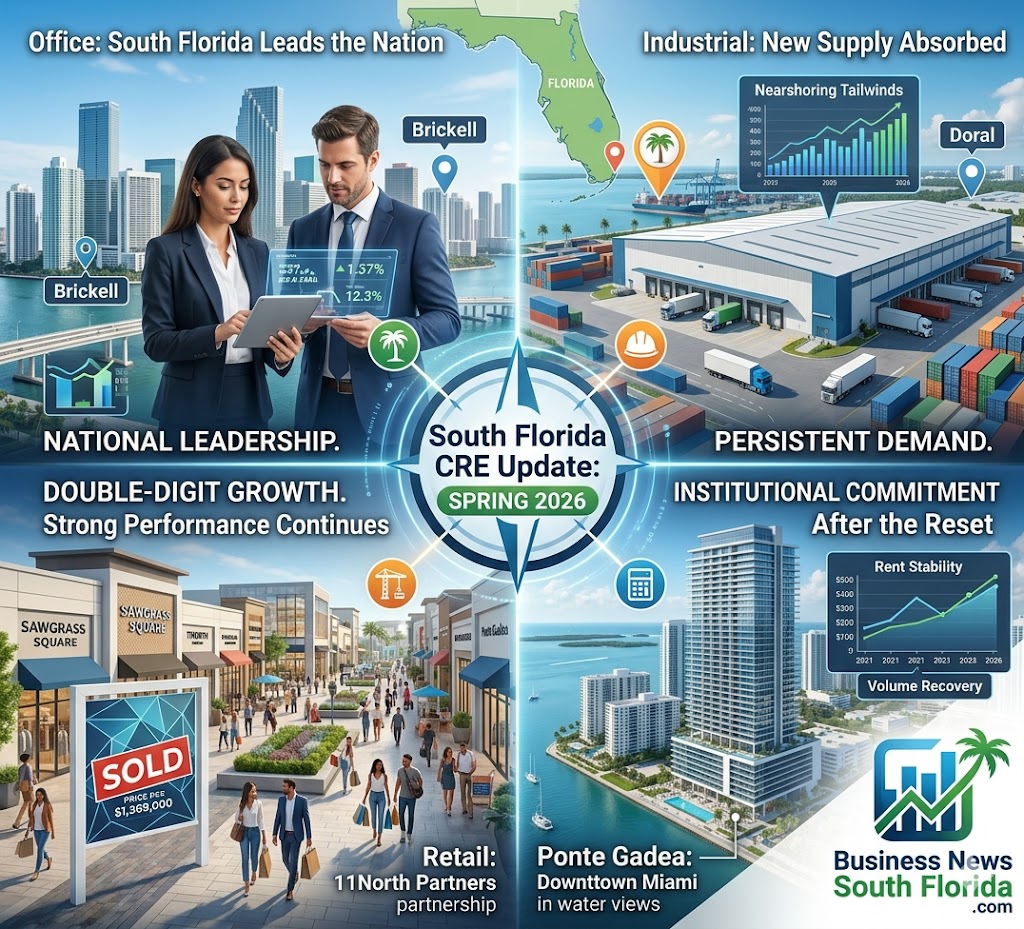
Office: South Florida Leads the Nation
The South Florida office market in spring 2026 tells a story that contradicts most of what national office market headlines suggest.
National Leadership Position
The West Palm Beach-Boca Raton Market Area and the Miami Market Area posted the lowest office vacancy rates among the nation’s largest markets in February 2026 — well below the national vacancy rate of 17.6%.
The specific numbers tell a remarkable story:
The West Palm Beach-Boca Raton Market Area office vacancy rate declined to 11.3% in February 2026, down from 11.9% in February 2025.
In the Miami Market Area, the office vacancy rate decreased to 12.8%, down from 15.7% in February 2025.
In the Fort Lauderdale Market Area, the office vacancy rate eased to 15.8%, down from 16.8% in February 2025.
Each major South Florida office submarket recorded year-over-year vacancy improvement during a period when national office vacancy continued to face substantial challenges. The performance reflects exactly the dynamics that have made South Florida one of America’s most consequential office markets.
Brickell’s Continued Dominance
Brickell has the lowest vacancy rate of 3.7% among South Florida’s major submarkets, a reflection of the strong demand for Class A+/A space in prime locations.
The Brickell market dynamic remains genuinely extraordinary. 830 Brickell, Miami’s flagship tower, has seen intense demand despite high rents, with the tower fully leased even as asking rents climbed to record highs. Four large tenants — potentially including Citadel, Microsoft, and Thoma Bravo — were vying for 27,000 square feet vacated by Banco Master after its lease was terminated.
The continued Citadel expansion remains particularly consequential. Citadel, which recently leased two additional floors in 830 Brickell, continues to grow its presence in Brickell. The Ken Griffin-led private capital firm continues anchoring the broader Wall Street South narrative through substantial Miami operational expansion.
Major Lease Activity
Spring 2026 has continued producing major lease activity across South Florida:
West Palm Beach — Stephen Ross scored another notable lease for One Flagler, securing a 50,000 SF lease with Wells Fargo who is moving its wealth management HQ to West Palm Beach. The 200,000 square foot office lease of cloud-computing company ServiceNow at 10 CityPlace was the most notable office lease deal in 2025.
Miami Wynwood — The most notable Miami leases include Amazon’s 50,000 SF lease at Wynwood and Peter Thiel’s office lease at Wynwood which will serve as Palantir HQ. Other notable leases include those of Verizon, Assurant, Uber, ADP, and Sidley Austin.
Fort Lauderdale — The most notable transaction is the 34,000 office lease of MSC Cruises, which makes it the largest lease in the Cypress Creek submarket.
Office Construction Pipeline
The South Florida office construction pipeline tells its own story about continued institutional confidence:
The West Palm Beach-Boca Raton Market Area and the Miami Market Area have the most intense construction activity among the nation’s 25 largest markets when measured as a percentage of existing office stock. Currently, 3.9 million square feet (MSF) of office space is under construction and slated for completion in 2026-2028, according to Yardi Matrix, adding 2% to inventory. About 2.1 MSF is projected to be completed in 2026, adding 1% to existing office inventory, compared to 0.4% nationally.
The major projects shaping the South Florida office landscape include:
West Palm Beach Projects — 2.0 MSF under construction with 633,059 SF to be completed in 2026. Related Ross’ projects 15 CityPlace (481,000 SF) and 10 CityPlace (468,000 SF) in West Palm Beach are the largest office projects underway in South Florida, with expected completion dates of 2027 and 2028, respectively.
Miami Projects — 1.6 MSF under construction with 1.21 MSF slated for completion in 2026, adding 1.3% to existing inventory. The largest project expected to be completed in 2026 is the Royal Caribbean Headquarters in Miami, the 3rd largest office under construction in South Florida.
Continued Corporate Expansion
South Florida office expansions are outpacing new-to-market leases, with 671K SF absorbed in 2025. Major tenants like Amazon and Uber are increasing Miami footprints soon after initial moves. Major companies including Amazon, Uber, and financial services firms like CI Financial and Corient have quickly outgrown initial leases.
Some companies in South Florida are planning to expand their office footprints by as much as tenfold in 2026, with many selecting locations with neighboring vacancies to ensure future growth options. Miami’s business-friendly climate, notably no state income tax, continues to attract firms threatened by higher taxes elsewhere.
Brian’s Take: South Florida Office Is the Most Surprising National CRE Story of 2026.
While national office market headlines continue focusing on substantial vacancy challenges in markets including San Francisco, Chicago, and Los Angeles, the South Florida office story represents a genuinely different narrative — declining vacancy rates, substantial corporate expansion, continued major lease activity, and intense construction activity adding inventory at substantially higher rates than the national average. The Brickell market dynamic with sub-4% vacancy and continued rent growth at premier buildings like 830 Brickell represents exactly the kind of supply-constrained market that produces both substantial landlord pricing power and the conditions where major institutional capital genuinely wants to deploy. Florida operators across multiple industries should pay attention to the office market dynamic because it both reflects and drives the broader South Florida business expansion that continues reshaping the region.
— Brian
Industrial: Working Through New Supply
The South Florida industrial market in spring 2026 reflects the substantial new supply being absorbed across the region.
Miami-Dade Industrial
Driven by persistent demand, 3.2 million square feet were leased in Miami-Dade Q1 2026, with rental rates climbing to $17.04 PSF NNN by quarter-end, a 1.5% year-over-year increase. However, because of 1.4 million square feet of new supply and negative absorption totaling 124,300 square feet, the vacancy rate rose to 7.1%, up 20 basis points from last quarter. With 2.9 million square feet still under construction, market fundamentals may continue to fluctuate as new supply gets absorbed.
The Savills data tells a complementary story: vacancy reached 8.0% in Q1 2026 — the highest level in the past five years and 320 bps above the five-year quarterly average of 4.7%. The rise is primarily driven by a substantial wave of new supply that continues to be absorbed at a gradual pace. Vacancy is more pronounced in larger big box buildings exceeding 100,000 square feet, as occupiers increasingly favor smaller spaces under 50,000 sf.
Palm Beach County Industrial
The Palm Beach County industrial sector showed varied performance in Q1 2026 as the market moved toward stabilization. Leasing activity was light compared to historical quarterly averages and absorption dipped negative pushing the vacancy rate up 40 basis points quarter-over-quarter to 7.2%. Moving forward, market fundamentals are expected to improve, as the amount of product under construction begins to dwindle with only 797,000 square feet left. Leasing activity totaled 469,000 square feet, the lowest level in two years. Asking rents leveled off at $15.98 PSF NNN.
Cap Rate Stability
As South Florida industrial cap rates expanded to an average of 6.3% to offset higher borrowing costs, pricing levels generally held steady, preventing a material decline in price‑per‑square‑foot valuations. The recent stability in cap rates indicates that the market has reached a point of alignment between buyer yield expectations and seller pricing assumptions, a balance likely to persist through 2026.
Submarket Dynamics
Doral remains the logistics powerhouse, with rents for Class-A distribution space often exceeding $18-$20 PSF. Medley keeps its spot as a favorite for 3PL providers because of its accessibility and major transit corridors. Hialeah is currently the tightest submarket in the region, with vacancies often dipping below 2% — the go-to destination for last-mile delivery and small-bay users.
Nearshoring Tailwinds
In 2026, the economy benefits largely from macroeconomic trends towards nearshoring. With large companies now choosing Latin America rather than Asia for their manufacturing, Miami’s Port and Airport have become key nodes in the movement of those goods through the North American market. As such, there has been increased demand for “Flex” spaces; properties that contain both warehousing components and high-quality office space for regional head offices.
Multifamily: Stabilizing After the Reset
The South Florida multifamily market in spring 2026 reflects continued normalization following the substantial reset of 2023-2024.
Pricing Dynamics
The average price per unit in South Florida multifamily settled at $325,921 at the end of Q1 2026, down marginally from the previous quarter but up 15.7% from last year. With relatively steady rent and stabilized occupancy, the region’s annual trailing average price per unit rose, ending Q1 2026 at $312,091. Price discovery is expected to continue as buyers and sellers settle into the market following post-pandemic record high rents, occupancy, and construction levels.
Continued Caution
Despite easing interest rates, multifamily sales activity in South Florida remains subdued as elevated insurance and operating costs influence pricing, even as cap rates hold steady near 5.0% and help support values.
Substantial Construction Pipeline
The Cushman & Wakefield data on the Miami multifamily pipeline shows substantial continued development activity: the Miami multifamily construction pipeline totaled near 15,000 units, with Downtown Miami representing the largest share of development activity in Q4 2025.
Volume Recovery
Multifamily was the largest sales volume category in 2025 at $4.9 billion, with sales growth of 18% year-over-year. The category remained the largest commercial real estate sales sector through 2025, reflecting continued institutional commitment despite the operating cost challenges affecting the sector.
Retail: Strong Performance Continues
The South Florida retail market continues demonstrating substantial strength.
Sales Volume Leadership
Commercial real estate retail sales increased at a double-digit pace across the core four asset types, with retail leading at +42% growth in 2025 — making retail one of the strongest performing categories in the regional commercial real estate market.
Volume Distribution
Retail sales volume in 2025 reached $4.0 billion, tied with industrial as the second-largest commercial real estate category behind multifamily.
Major Retail Transactions
The Sawgrass Square acquisition for $234 million represented one of the major retail-anchored transactions of 2025, acquired by the Bain Capital Real Estate and 11North Partners partnership.
The continued retail strength reflects multiple factors including the substantial domestic migration into South Florida, continued tourism activity, growing local consumer base, and broader retail sector recovery following pandemic-era challenges.
Brian’s Take: Retail’s Performance Has Been Genuinely Underappreciated Given the Broader Narrative About Retail Challenges.
While much national commercial real estate narrative continues focusing on retail sector challenges, the South Florida retail story tells a substantially different narrative — leading sales volume growth, major institutional acquisitions, continued strong fundamentals across multiple submarkets, and the kind of buyer interest that supports continued price discovery. The combination of South Florida’s substantial population growth, continued tourism activity, growing local consumer base, and broader market dynamics has produced retail real estate performance that genuinely deserves more attention than it typically receives in regional commercial real estate conversations.
— Brian
Investment Climate: Selective but Active
The broader spring 2026 investment climate across South Florida commercial real estate reflects the broader market maturation.
Capital Markets Recovery
The Mortgage Bankers Association forecast for 2026 reflects substantially recovering capital markets: total commercial mortgage originations are projected to increase 27 percent to $805 billion in 2026.
Investor Selectivity
After several years of aggressive growth and speculative underwriting, commercial real estate investors across Southwest Florida are entering 2026 with a markedly different mindset. The market has shifted away from speculation and toward disciplined, fundamentals-driven decision-making, signaling a broader reset rather than a retreat. Over the past 12 months, investor behavior has clearly evolved. Capital remains active, but it is more selective, more cautious, and increasingly focused on long-term value creation. Stretch underwriting and growth-at-all-costs strategies have largely faded, replaced by a renewed emphasis on asset quality, tenant strength, and predictable cash flow.
Flight to Quality
Across all major asset classes, investors are prioritizing well-located properties with stable, creditworthy tenants.
Institutional Confidence
The continued major institutional transactions — Ponte Gadea’s Sabadell acquisition, Bain Capital’s Sawgrass purchase, the various Las Olas trophy office acquisitions, the continued Brickell tower activity, the substantial multifamily pipeline — reflect continued institutional confidence in South Florida commercial real estate fundamentals.
County-Specific Performance
Each major South Florida county shows distinct dynamics in spring 2026.
Miami-Dade County
Miami-Dade County commercial sales rose 32% in 2025 to $7.1 billion, leading the South Florida region in commercial sales activity.
The county continues anchoring the broader regional commercial real estate activity, with the substantial Brickell office market, continued industrial activity in Doral and surrounding submarkets, major multifamily activity, and substantial retail activity all contributing to comprehensive commercial real estate strength.
Broward County
Broward County commercial sales rose 27% in 2025 to $5.5 billion, with the county capturing two of the major 2025 office transactions: the Bank of America Financial Center on Las Olas Boulevard for $221 million and the Las Olas Center on Las Olas Boulevard for $208 million.
The Las Olas trophy office market has emerged as one of the most consequential South Florida commercial real estate stories, with multiple major institutional acquisitions reflecting continued confidence in the Fort Lauderdale CBD as a major South Florida business center.
Palm Beach County
Palm Beach County commercial sales rose 12% in 2025 to $2.8 billion, with continued growth supported by the substantial financial industry migration anchored by major firms including Goldman Sachs Asset Management’s West Palm Beach operations, Elliott Investment Management, and the continued Wall Street South dynamic.
Martin and St. Lucie Counties
Commercial sales rose 1% in Martin County to $181 million and 21% in St. Lucie County to $367 million, with continued growth supported by the broader Treasure Coast development activity and the continued migration patterns affecting the region.
What Comes Next: Spring 2026 Outlook
Several factors will continue shaping South Florida commercial real estate across the months ahead.
Continued Office Demand
The continued corporate expansion activity — particularly anchored by Citadel’s continued Brickell expansion, the continued Amazon and Uber Miami growth, and the broader Wall Street South migration — should continue driving office demand at premier locations across South Florida.
Industrial Supply Absorption
The substantial industrial new supply will continue requiring absorption across the months ahead, with implications for vacancy rates, rent growth, and broader industrial market fundamentals. The Miami-Dade pipeline of 2.9 million square feet under construction combined with Palm Beach County’s remaining 797,000 square feet under construction represents substantial supply that will continue affecting market dynamics.
Multifamily Stabilization
The continued multifamily stabilization should continue as the substantial construction pipeline gets absorbed and operating cost dynamics — particularly insurance and operating costs — continue normalizing.
Continued Capital Activity
The continued capital markets recovery and continued institutional capital interest should continue supporting major transaction activity, with continued opportunities for both sellers seeking liquidity and buyers seeking deployment opportunities in the fundamentally strong South Florida market.
Insurance and Operating Cost Considerations
Continued insurance market dynamics and broader operating cost considerations will continue affecting commercial real estate underwriting, valuation, and broader market dynamics.
Hurricane Season Approaching
The approaching 2026 hurricane season represents an ongoing consideration affecting Florida commercial real estate broadly. Property owners, lenders, insurers, and investors continue navigating the climate and insurance dynamics that have become increasingly central to Florida commercial real estate practice.
Continued Migration Tailwinds
Domestic migration is likely to pick up further in 2026-2027 with New York and California eyeing to impose higher corporate taxes and income taxes on millionaires and billionaires. The continued migration patterns should continue supporting the broader demand dynamics across all South Florida commercial real estate sectors.
Selective but Active Market
The most likely path over the next 12 to 24 months is a continued improvement in transaction volume, better refinancing execution, and selective cap rate compression for industrial, multifamily, and necessity-based retail assets, assuming interest-rate volatility remains contained. Office should continue to split into two markets: prime, well-located assets in growth corridors should lease and finance better, while commodity office and older buildings remain the most probable source of discounted sales, recapitalizations, and distress.
Brian’s Take: Spring 2026 Represents a Genuinely Favorable Environment for Sophisticated South Florida Commercial Real Estate Operators.
The combination of continued institutional capital interest, leading national office performance, substantial industrial supply absorption opportunities, retail strength, multifamily stabilization, and continued migration tailwinds creates exactly the kind of multi-sector commercial real estate environment that rewards sophisticated operators with capital, capability, and conviction. The South Florida commercial real estate story in spring 2026 isn’t dramatic — there are no headlines about explosive growth or catastrophic decline — but the underlying fundamentals reflect exactly the kind of healthy, mature, sophisticated market environment that produces durable returns across multiple cycles. The operators who deploy thoughtfully into this environment — focusing on quality assets, prime locations, strong tenants, predictable cash flow, and disciplined underwriting — should position themselves for substantial continued performance as the South Florida commercial real estate evolution continues across the months and years ahead.
— Brian
The Bottom Line: A Mature, Sophisticated South Florida CRE Market
The South Florida commercial real estate market in spring 2026 represents one of the most consequential American commercial real estate stories — combining continued strong fundamentals across multiple sectors, substantial institutional capital interest, leading national performance in office markets, working through new industrial supply, stabilizing multifamily conditions, strong retail performance, and continued migration tailwinds supporting long-term demand.
For commercial real estate investors, the market environment rewards sophisticated capital deployment focused on quality assets, prime locations, strong tenants, and disciplined underwriting rather than the speculative dynamics of recent cycles.
For commercial real estate operators, the environment supports continued business activity across multiple sectors with continued opportunities for those willing to engage thoughtfully with the market’s current sophisticated dynamics.
For South Florida businesses navigating commercial real estate decisions, the environment provides substantial options across office, industrial, retail, and multifamily categories with continued capital available to support transactions.
For South Florida professional services firms — including legal, accounting, financial advisory, brokerage, lending, and broader professional services — the continued substantial commercial real estate activity provides continued opportunities for engagement with one of the most consequential American commercial real estate markets.
The transactions continue. The capital deploys. The leases sign. The construction continues. The market matures. The fundamentals remain strong. The opportunities continue developing. The South Florida commercial real estate story continues evolving across the months and years ahead.
That’s the South Florida commercial real estate reality in spring 2026.
That’s a Florida economic and investment environment worth understanding seriously — and one that will continue producing substantial implications for South Florida economic development, commercial real estate activity, and broader regional business activity across the months and years ahead.
Disclaimers and Methodology
Article Purpose and Methodology. This article provides an analysis of the South Florida commercial real estate market as of spring 2026, based on publicly available Q1 2026 market reports and analysis from sources including Colliers International, CBRE, Cushman & Wakefield, Savills, MIAMI REALTORS, the Mortgage Bankers Association, and additional commercial real estate industry sources. The data and analysis reflect publicly available information at time of writing. Commercial real estate market conditions evolve continuously; specific market data, transactions, and conditions may differ from the information presented as continued market developments occur.
Important Limitations. This article is not investment, legal, tax, financial, or commercial real estate professional advice and should not be relied upon for any specific investment decision, transaction, or other consequential commercial real estate matter. Commercial real estate involves complex considerations that vary substantially based on specific property characteristics, market conditions, capital structure, regulatory considerations, tax implications, insurance considerations, environmental factors, and dozens of other factors specific to individual situations. Specific commercial real estate decisions require qualified commercial real estate brokers, attorneys, accountants, financial advisors, lenders, and other qualified professionals with relevant experience — not reliance on general informational articles. Market data including vacancy rates, sales volumes, transaction details, cap rates, rental rates, and broader market metrics reflect publicly available sources at time of writing and may have changed since publication. Always consult qualified commercial real estate professionals, current market reports from major commercial real estate research firms, and qualified advisors for advice specific to your investment situation. The author and publisher disclaim any liability for outcomes resulting from the use, application, or interpretation of information in this article.
Resources & Further Reading
- Colliers International South Florida Research — Comprehensive South Florida commercial real estate research and quarterly market reports across office, industrial, multifamily, and retail sectors.
- CBRE South Florida — Major commercial real estate firm with comprehensive South Florida research including the annual 2026 U.S. Real Estate Market Outlook for South Florida.
- Cushman & Wakefield Miami MarketBeats — Quarterly Miami commercial real estate market reports across major sectors.
- MIAMI REALTORS Commercial Market Reports — Comprehensive Southeast Florida commercial real estate research and quarterly market reports.
- Savills South Florida Research — Major commercial real estate research firm with comprehensive South Florida market analysis.
- Mortgage Bankers Association Commercial Real Estate — National commercial real estate finance research including 2026 forecast for commercial mortgage originations.
- Florida Realtors Commercial Real Estate — Statewide Florida realtors organization with commercial real estate research and market data.
- U.S. Census Bureau Population Data — Federal population data supporting the migration patterns affecting South Florida commercial real estate demand.
About Brian French
Led by a commitment to tech-intelligent curation, Brian French tracks and analyzes the Business News in South Florida including corporate developments defining Florida's economy. Brian brings an extensive financial background to his analysis, having graduated from the University of South Florida in Finance and serving as a Vice President and Portfolio Manager for Merrill Lynch Private Investors and the Trust Department in St. Petersburg, FL, as well as a Vice President and Trust Investment Officer for SunTrust Bank in Sarasota, FL. His writing blends macroeconomic trends, capital markets, corporate strategy, and modern digital insights for a sophisticated look at Florida's dynamic business economy.