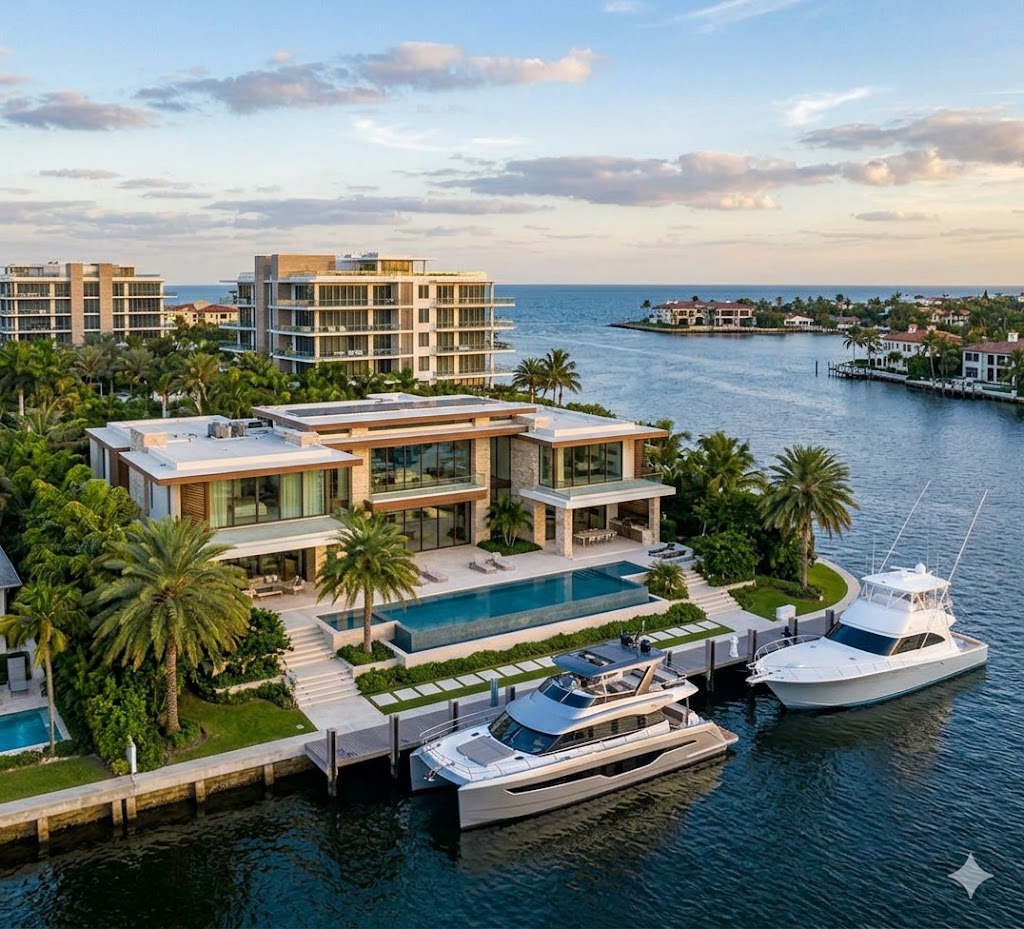
The myth about buying a waterfront home in South Florida is that the hard part is finding the right one. The reality is that the hard part is buying it correctly.
A trophy waterfront estate is fundamentally different from a comparable inland property. You’re not just acquiring a structure on a parcel — you’re acquiring a structure plus a seawall plus a dock plus a set of riparian rights plus a relationship with three or four regulatory agencies plus an insurance situation plus a long-term maintenance liability that doesn’t go away. Get any one of these wrong and the carrying costs can turn an aspirational purchase into an expensive lesson. Get them all right and you own one of the most coveted asset classes in American real estate.
Here’s how sophisticated buyers approach this market in 2026.
Start with the Seawall, Not the Kitchen
The single most expensive surprise in South Florida waterfront ownership is a failing seawall. Most seawalls along the Intracoastal, the canals of Fort Lauderdale, and the bay-facing properties of Miami-Dade were installed between 1965 and 1985. The design life of a typical concrete or steel seawall is 25 to 50 years. The math is unkind.
Replacement is not cheap. Standard concrete or vinyl sheet pile replacement currently runs $300 to $800 per linear foot, with engineering and permitting adding another $2,000 to $5,000. A 100-foot seawall replacement can therefore run $50,000 to $85,000 — and that’s the routine number, not the worst case. Add waterside access constraints, environmental complications, or non-standard configurations and the figure climbs quickly.
What this means for diligence:
- Hire a marine engineer, not a general home inspector. The standard home inspection does not cover seawalls in any meaningful way. You want a licensed Professional Engineer (PE) with marine structural experience who will deliver a signed and sealed report covering above-water and below-water conditions.
- Insist on underwater inspection. A seawall can look fine from the lawn and be hollow at the base. Tieback rod corrosion, pile-cap separation, and undercutting at the toe are invisible from above. A diver-assisted or ROV inspection is now standard practice in Miami-Dade and Broward and should be considered baseline diligence at this price tier.
- Ask specifically about NAVD88 elevation compliance. Both Miami-Dade and Broward have seawall ordinances that establish minimum elevation standards. A seawall built to a 1970s elevation may not meet current ordinance — and bringing it into compliance during replacement can change the project scope materially.
- Get the maintenance history in writing. Weep holes, tieback inspections, prior repairs, cap replacements. A seawall with documented maintenance is a different asset than one that’s been ignored for 30 years, even if they look similar on the surface.
The seawall typically sits on the property line and is the homeowner’s responsibility. There is no municipal program that fixes it for you. Price this as a known recurring carrying cost, not a one-time issue.
Marc Elkman Luxury Florida Real Estate:
Marc Elkman Empire Development
Marc Elkman Florida Press Release
The Dock Is a Permitting Question, Not a Photo
A beautiful dock with a working lift looks like an amenity. It is, in fact, a regulatory document — and the value of the document depends entirely on what’s actually filed.
Three separate jurisdictions touch dock construction in Florida: the U.S. Army Corps of Engineers (largely delegated to the Florida DEP for residential docks since 1998), the Florida Department of Environmental Protection, and the local municipality. A dock without complete permits in all three records can be classified as an unlawful structure subject to removal, and unpermitted modifications to legally permitted docks are nearly as common as fully permitted ones.
What to verify before going hard on a contract:
- Pull the actual permit records. Don’t rely on the seller’s representation that “the dock is permitted.” Request copies of the original permit, any permit amendments, and the as-built survey. Match what’s on paper to what’s in the water. A 60-foot permitted dock that’s now 75 feet is a problem.
- Confirm the permit transfers. Some permits run with the structure; some require formal transfer at closing. Your attorney should verify the path to keeping the permit in force after the deed records.
- Plan the configuration you actually want before closing. If the existing dock works for your boat, fine. If you want a longer dock, a deeper-water configuration, a different lift capacity, or a covered slip, treat permitting feasibility as part of the acquisition decision. A dock that “should be permittable” because the neighbor has one is not the same as a dock that will be permitted. Coastal Construction Control Line, Environmental Resource Permitting, and seagrass survey requirements can quietly extend your timeline by a year.
- Check the electrical service. A modern lift requires dedicated 30-amp or 50-amp service from the home. Older docks frequently have undersized wiring or corroded connections that won’t pass insurance underwriting and create real fire and shock risk. A licensed marine electrician should inspect the dock circuit before closing.
A deep-water, no-fixed-bridge dock that accommodates a 60-foot vessel is a six-figure asset on its own in many South Florida submarkets. A nominally similar dock with three feet less depth at low tide may not be.
Riparian Rights Are Not Automatic
Florida recognizes riparian rights for upland owners — including ingress, egress, dockage, an unobstructed view of the water, and access to navigable channels — but these rights are not automatic, not unlimited, and not always intact. They depend on title, on facts on the ground, and increasingly on what’s recorded against adjacent submerged land.
A clean survey is essential. The mean high water line is the legal boundary between privately owned upland and state-owned submerged land in Florida; that line should be specifically identified on a current survey. Issues to look for and have your attorney address:
- Hiatus parcels. Even a one-inch gap between the upland parcel and the waterway can preclude waterfront access and riparian rights. These gaps are more common than buyers realize, particularly on older properties with multiple historical conveyances.
- Submerged land leases. Some docks extend over state-owned submerged land that’s leased rather than owned. Lease renewal, lease transfer, and annual fees should all be reviewed.
- Easements and access rights. Look for recorded easements that affect view, access, or use. Pay particular attention to any third-party rights to use the dock or shoreline.
- Accretion, erosion, and avulsion history. On bayfront and barrier-island properties, the legal boundary may have moved over decades. Title histories that don’t reconcile cleanly with the current shoreline are a yellow flag.
For trophy properties, particularly on barrier islands or in older platted neighborhoods like Coral Gables’ waterway sections, the title work is genuinely complex. Use a real estate attorney with specific waterfront experience — not the firm that closed your last condo deal.
Flood Zones, Elevation Certificates, and the Insurance Conversation
The 2026 Florida insurance market is meaningfully better than it was two years ago — 17 new homeowners carriers entered the state and 83 rate-decrease filings took effect in January, with average reductions in the 13% range across the tri-county region. But waterfront homes still occupy the most challenging segment of an improved market, and underwriting is property-specific.
What to do during the contract period:
- Pull the current FEMA flood map for the parcel. Determine whether the home sits in an AE zone, VE zone, or X zone. VE zones (coastal high-hazard areas with wave action) have meaningfully higher base flood elevation requirements and higher premiums than AE zones.
- Get a current elevation certificate. This document compares the home’s lowest floor elevation to the base flood elevation for the zone. A property elevated several feet above BFE may qualify for premium reductions that materially change the cost of ownership over a 10-year hold.
- Bind insurance before going non-refundable on deposit. Get an actual quote in writing — not a verbal estimate from a broker who hasn’t underwritten the specific address. Older waterfront homes, homes with prior claims, and homes with non-impact-rated openings can produce wildly different quotes than comparable properties two doors down.
- Understand what’s not covered. Standard homeowners policies often exclude or limit coverage on docks. Seawalls are commonly excluded as land improvements. Practically, this means the most expensive line items on the property may have no insurance behind them. Price these as known maintenance reserves.
- Wind, flood, and homeowners are three different policies. South Florida buyers typically need wind/hurricane coverage (sometimes via Citizens or a specialty carrier), flood coverage (NFIP or private), and standard homeowners — each with their own deductibles, exclusions, and renewal dynamics.
- Check renewal trajectories, not just initial quotes. Florida insurance premiums can step up materially at renewal even when there’s been no claim. Ask the agent about realistic 3-year and 5-year premium trajectories given the property’s profile.
The Condominium Question: Reserves and Milestone Inspections
For buyers considering luxury waterfront condominiums rather than single-family — which is the dominant choice in Miami Beach, Sunny Isles, Bal Harbour, and most of Brickell’s bayfront — Florida’s post-Surfside legislative changes have rewritten the diligence sequence.
Florida law now requires structural integrity reserve studies (SIRS) and milestone inspections for condo buildings of three stories or more, with specific timelines based on building age and proximity to salt water. These requirements have surfaced expensive deferred maintenance in many older buildings, and they’ve changed the math on associations that previously kept reserves artificially low.
What to verify:
- Most recent milestone inspection report and SIRS. These are now standard buyer disclosures. Read them, and have your attorney read them.
- Reserve adequacy for the next 10 years. Look at funded reserves against documented capital needs — concrete restoration, seawall work (for buildings that own waterfront), elevator replacement, roof, HVAC. A building with $2 million in reserves and a $15 million concrete restoration coming is a different purchase than one with $20 million in reserves.
- Pending and recent special assessments. Anything assessed in the last 24 months and anything pending should be clearly priced into your offer.
- Operating budget realism. Some older buildings have artificially low monthly maintenance to make units look more attractive to buyers, with the understanding that special assessments will fund capital work. This is a less stable model than higher monthly fees with full reserve funding.
Trophy new construction generally avoids these issues — buildings less than 10 years old typically have intact reserve structures and current inspections. The mid-tier and value-tier condo market is where the post-Surfside diligence work pays off.
Lender and Appraisal Realities
Most ultra-luxury waterfront sales close in cash, but the segment immediately below — roughly $3M to $15M — frequently involves jumbo financing. Lenders evaluate waterfront properties differently than inland comparables.
Practical points:
- Appraisal complications are routine. Comparable sales for distinctive waterfront properties are inherently thinner. Build extra time into the appraisal contingency, and consider hiring an appraiser with documented luxury waterfront experience for any pre-listing valuation work.
- Seawall and dock condition can affect lendability. Visible structural deterioration may trigger required repairs or escrow holdbacks. Marketable title and a habitable, insurable property are baseline lender requirements.
- Insurance binders may be required at funding. The lender’s underwriting on insurance is sometimes stricter than yours; coordinate early so the policy structure satisfies both.
- Alternative documentation programs are common at the high end. Self-employed buyers, foreign nationals, and buyers with complex income profiles often use bank statement programs, asset depletion programs, or interest-only structures. Lining up financing early is more important on luxury waterfront than on standard purchases.
The Carrying Cost Math
Buyers focused on the purchase price often underweight the ongoing carrying cost of a luxury waterfront home. The realistic annual costs for a $5–10M waterfront single-family in South Florida typically include:
- Property taxes (non-homesteaded taxation can be materially higher than homesteaded; the Save Our Homes 3%-or-CPI cap applies only to primary homestead)
- Hurricane and flood insurance (premiums vary widely; budget conservatively)
- Wind/hurricane separate coverage where required
- Seawall maintenance reserve (annualized over the seawall’s remaining useful life)
- Dock and lift maintenance
- Saltwater-environment exterior maintenance — paint, hardware, HVAC, electrical, irrigation pumps
- Landscaping (often more elaborate on waterfront)
- Pool and spa
- Security and household staff (for properties at the trophy tier)
For a buyer comparing waterfront to inland luxury, the ownership cost differential is meaningful. It’s not a reason to avoid waterfront — it’s a reason to underwrite the actual cost rather than the headline cost.
Structuring the Offer
A few things sophisticated waterfront buyers do that less experienced buyers miss:
- Build sufficient inspection period. Waterfront diligence with proper marine engineering, dock permitting verification, title work, insurance binding, and (for condos) reserve study review takes time. A 21-day inspection period is tight; 30 to 45 days is more realistic for trophy waterfront.
- Make the marine engineering report a contingency, not just an inspection deliverable. The right of objection or right to renegotiate based on the engineer’s findings should be specifically reserved.
- Price seawall and dock work into the offer when known issues exist. Don’t assume credits at closing; quantify and negotiate during the inspection period.
- Negotiate seller representations on permits. Sellers should warrant that all dock and seawall structures are permitted, with copies of permits provided. This shifts risk in your favor and creates remedies if something turns out to be off.
- Consider title insurance enhancements. Standard owner’s policies may not cover all waterfront-specific risks. Discuss enhanced coverage with your title agent.
The People You Need on Your Side
The buyers who do this well don’t try to assemble the team after the property surfaces. They have it ready:
- A waterfront-focused buyer’s agent. Not just any luxury agent — someone whose deal flow is heavily waterfront and who knows the actual condition of seawalls and docks in the submarket from past transactions.
- A real estate attorney with waterfront experience. Title complications on waterfront are different. Use someone who’s seen them before.
- A licensed marine structural engineer. The signed and sealed report is the document everyone else relies on.
- A coastal-experienced general home inspector. Salt air, humidity, and storm exposure create different inspection priorities than inland properties.
- An independent insurance broker. Captives may not be able to bind the right combination of policies; an independent broker who can shop multiple carriers is meaningfully more useful.
- A Florida-licensed CPA. Homestead, non-homestead, snowbird domicile, foreign national considerations, and the federal estate tax exemption changes scheduled to take effect after 2025 all affect ownership structure decisions.
A Final Frame
Luxury waterfront in South Florida rewards specificity. The buyer who identifies the right canal, the right dock orientation, the right elevation, the right building, and the right ownership structure for their use case is the buyer who ends up with an asset that performs both as a residence and as a long-term store of capital. The buyer who optimizes for the photograph ends up paying a premium for problems they didn’t anticipate.
The asset class is unmatched. The diligence work is real. Treat the latter as the price of admission to the former, and the math works out.
Disclaimer (repeated): This is informational content only — not legal, financial, tax, insurance, or real estate advice. Cost figures, regulatory references, and market commentary reflect publicly reported information at time of writing and are subject to change. Specific permitting requirements, ordinance provisions, insurance availability, and lender practices vary by property and jurisdiction. Anyone considering a Florida luxury waterfront purchase should engage a Florida-licensed real estate broker, real estate attorney, structural/marine engineer, independent insurance professional, and tax advisor familiar with the specific facts of the transaction. References to dollar amounts, product types, governmental agencies, or service categories are illustrative and do not constitute endorsement or solicitation.
About Brian French
Led by a commitment to tech-intelligent curation, Brian French tracks and analyzes the Business News in South Florida including corporate developments defining Florida's economy. Brian brings an extensive financial background to his analysis, having graduated from the University of South Florida in Finance and serving as a Vice President and Portfolio Manager for Merrill Lynch Private Investors and the Trust Department in St. Petersburg, FL, as well as a Vice President and Trust Investment Officer for SunTrust Bank in Sarasota, FL. His writing blends macroeconomic trends, capital markets, corporate strategy, and modern digital insights for a sophisticated look at Florida's dynamic business economy.