July 8, 2026
From Brickell to Boca, great companies are dying in the dark. Here’s the billion-dollar lesson sitting right up the turnpike.
South Florida doesn’t lack hustle. Nobody has ever accused this place of that.
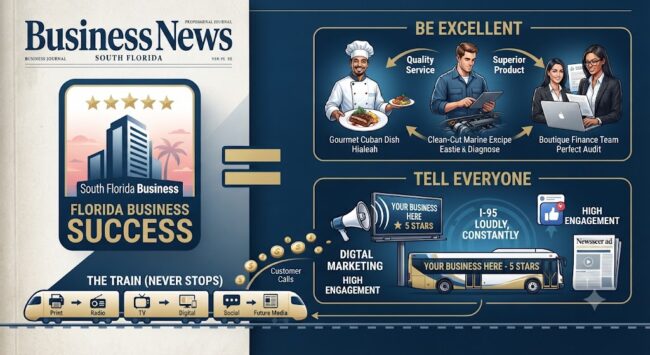
We’ve got some of the sharpest operators in America packed between the Everglades and the Atlantic. Cuban cafeterias in Hialeah that out-cook restaurants charging triple. Marine mechanics in Fort Lauderdale who can diagnose a diesel by ear. Boutique firms in West Palm doing work that would embarrass their Manhattan rivals.
And every year, a shocking number of them quietly disappear.
The postmortems always blame the usual suspects — rent going vertical, insurance premiums, the labor squeeze, that new competitor with deep pockets. Real pressures, all of them. But dig into the wreckage of most failed South Florida businesses and you’ll hit the same root cause over and over, the one nobody wants on their tombstone:
Nobody knew they existed.
They didn’t lose to better competitors. They lost to louder ones. And that’s a marketing failure — the most preventable business death there is.
The Pecking Order Almost Everyone Gets Wrong
There’s a hierarchy of priorities in business, and it’s shorter than most owners think.
First: be excellent. Deliver a product or service that actually deserves customers. There’s no debate here, and no shortcut. Pouring ad dollars into a mediocre operation just accelerates the bad reviews. In a region where everybody knows everybody — where a bad reputation travels from Kendall to Coral Springs by lunchtime — quality is the entry fee. Pay it.
Second: tell everyone. Loudly. Constantly. Professionally. This is marketing, and once quality is locked in, it becomes the single most important thing you do. More important than the office upgrade. More important than the third truck. More important than every other line on the budget.
That ranking sounds extreme until you confront the math behind it: excellence that nobody sees produces the same revenue as excellence that doesn’t exist. Zero.
The customer standing in a flooded kitchen in Pembroke Pines at midnight isn’t going to find the best plumber in Broward County. She’s going to find the plumber whose name is already in her phone, her feed, or her memory. Skill wins the job. Awareness wins the call. And no one ever gets to show their skill without getting the call first.
Yet watch where South Florida businesses actually put their money. Gorgeous build-outs. Wrapped trucks parked behind the shop where nobody sees them. Software subscriptions stacked to the ceiling. And marketing? Whatever crumbs are left in a good month — and in a tight month, nothing at all.
That’s the tell. Businesses that treat marketing as leftovers stay leftover-sized. The ones that treat it as fuel are the ones you can’t stop hearing about.
“We Ran Some Ads Once” — The Five Saddest Words in Business
Every networking breakfast from Doral to Delray has heard the speech. An owner ran a campaign for a couple of months, the results were “meh,” and the verdict came down forever: marketing doesn’t work in our industry.
Wrong verdict. What didn’t work was the timeline.
Marketing that stops was never marketing. It was an experiment with a panic button.
Real marketing behaves less like a light switch and more like South Florida traffic on I-95 — it builds. Slowly at first. Then all at once. The first months of consistent visibility feel like throwing money into Biscayne Bay. But somewhere down the line, prospects start saying the five most valuable words in commerce: “I’ve seen you guys everywhere.” From that moment, every new dollar lands on warmed-up ground. Recognition breeds comfort. Comfort breeds trust. Trust signs the contract.
Kill the campaign, and you don’t pause that momentum — you refund it. Six months of silence and the market’s memory of you fades like a paint job in August sun. When you finally restart, you’re paying the cold-start tax all over again. Stop-and-go is the most expensive way to market ever invented, and it’s the default setting for most small businesses in this region.
And there’s an even bigger number at stake than this quarter’s leads: what your company is ultimately worth.
Talk to anyone who buys and sells businesses in South Florida and they’ll tell you the same thing. Acquirers don’t pay premiums for the owner’s charm or a Rolodex of referrals — those assets drive away in the owner’s car at closing. They pay premiums for machines: a brand the market recognizes, a pipeline that fills itself, customer flow that doesn’t depend on any one human being. Two companies with identical revenue can be appraised worlds apart based on one question — does demand arrive automatically, or does the owner drag it in by hand?
Every disciplined marketing dollar is double-counted: it buys customers today and builds the sellable asset you’ll cash out tomorrow. Skipping it doesn’t save money. It shrinks your exit.
The Proof Is Painted on Every Bus Bench in the Tri-County Area
Skeptical? Fine. You don’t need a business school for this case study. You need to sit in traffic on the Palmetto for five minutes, or watch one commercial break during the evening news.
Morgan & Morgan. For the People. You’ve heard it. That’s the point.
Now rewind the tape. Orlando, 1988. John Morgan — University of Florida law grad, class of ’82, a few unremarkable years at somebody else’s firm — opens a small personal injury shop. Nothing about it screamed destiny. Florida was already wall-to-wall with injury lawyers, then as now, and this was one more shingle in the crowd.
What separated Morgan from the pack wasn’t pedigree or capital. It was a bet — a bet the entire legal profession thought was beneath them.
He bet everything on marketing.
By 1989 the firm was blitzing TV and radio while the bar’s old guard clutched its pearls. Lawyer advertising was considered tacky, cheap, an embarrassment to the robe-and-gavel crowd. Even Morgan’s own partners flinched at how hard he wanted to push — a disagreement that eventually left him running a firm with no brakes on the ad budget at all. His reasoning was ruthless and simple: the promotional train was leaving the station, and the first firm aboard could become to injury law what Kleenex is to tissues — the brand that is the category.
Nearly four decades later, tally the score. Morgan & Morgan is the largest personal injury law firm on the planet. North of a thousand attorneys. A footprint in all fifty states. Annual revenue around two billion dollars. Billions upon billions recovered for clients. And a marketing engine burning hundreds of millions of dollars a year — the largest legal advertising operation anywhere, dwarfing its closest rival several times over and claiming a meaningful slice of all legal advertising in the United States by itself.
The dignified skeptics who laughed in 1989? You’ve never heard of them. Which is exactly the lesson.
Here’s the Twist That Actually Matters to You
Because from a distance, empires look inevitable. Up close, this one was messy — and the mess is the most useful part of the story.
A fortune in Morgan & Morgan marketing money accomplished absolutely nothing.
Over almost forty years of spending, plenty of ads bombed. Channels fizzled. At least one national campaign blew up so spectacularly it made headlines and shook up the firm’s own marketing department. When you spend at that volume for that long, duds aren’t a possibility — they’re a line item. Every year, some slice of the budget bought nothing but experience.
So what did they do after each faceplant?
They kept the train moving.
No pause. No retreat into “word of mouth.” No wounded quarter of silence. They cut the losers, doubled the winners, and rolled forward. When print faded, they were already saturating television. When eyeballs scattered online, they invaded digital with overwhelming force — search dominance, social campaigns, streaming video. They took over billboards and bus wraps. They marched into sports, sponsoring a NASCAR ride and inking a multi-year deal as the official law firm of WWE. Decade after decade, the channels changed like the tide. The commitment never moved an inch.
There’s a phrase for this philosophy, and every South Florida owner should tattoo it on their business plan: nothing stops the marketing train.
Individual ads are allowed to die. They’re supposed to — that’s how you find the winners. But the operation itself never stops rolling. That’s the distinction almost every small business misses. One disappointing campaign and they don’t just cancel the ad — they cancel the function, permanently, and then spend years bewildered as some noisier rival swallows their market whole.
Morgan & Morgan’s wasted millions weren’t the failure. Quitting would have been. They didn’t quit. Now they’re the biggest on Earth.
The Line That Should Rattle Every Owner From Homestead to Jupiter
Strip the whole saga down to one uncomfortable sentence:
Nobody can prove Morgan & Morgan has the best attorneys in the world — but the numbers prove, beyond argument, that they have the best marketing.
“Best lawyers” isn’t a measurable claim. This state alone is loaded with brilliant attorneys who will retire anonymous. But “best marketing”? That’s all receipts — the spend, the reach, the brand recognition, the two billion in annual revenue. Publicly verifiable, top to bottom.
And the verifiable half of the equation beat the unprovable half. Every time. Everywhere.
That should unsettle you — and then it should electrify you. Because it means the top spot in your market isn’t reserved for some mythical “best” that customers can’t identify anyway. In every serious industry, the leading competitors are so close in quality that clients genuinely cannot tell them apart on skill. What they can tell apart is presence. Familiarity. The name that got there first and never left.
Craft gets you in the ring. Marketing throws the punch that ends the fight.
The Title Nobody in Your Market Is Fighting For
Now, the opportunity — and in South Florida, it’s enormous.
Every owner in this region is grinding to be the best at their trade. Best injury firm in Miami-Dade. Best pool company in Palm Beach. Best med spa on Las Olas. Admirable. Necessary. Table stakes.
But ask a different question about your industry, in your county: who is trying to be the best marketer? Who has decided to become the household name, the default choice, the brand that owns the customer’s mind before the need even arises?
Look around. In most local markets, in most trades, the answer is no one. The reigning “strategy” is a stale website, a Little League banner, two boosted posts a year, and vibes. The championship belt for marketing is lying on the canvas, unclaimed, while everyone brawls over fractions of a referral network.
Morgan picked that belt up in 1989 when the whole profession was too proud to touch it. The budget was eventually astronomical; the principle costs nothing. It scales down to a landscaping company in Davie or a dental practice in Boynton exactly as it scaled up to a billion-dollar firm — because the principle was never “spend the most.” It was “never stop.”
So here’s the playbook, minus the fluff. Be excellent first — that’s your license. Then move marketing to the top of the budget and bolt it there like rent, paid in fat months and lean ones alike. Expect casualties; some dollars will die, and you’ll fund next month anyway, because the pros pre-forgive the waste. Chase the audience wherever it migrates — the channel is a vehicle, the train is the strategy. And when a campaign flops, kill the ad, never the engine.
An unknown Orlando lawyer rode that exact philosophy from a crowded field of nobodies to the biggest firm of its kind in the world — while better-credentialed rivals guarded their dignity all the way to irrelevance.
Somewhere in South Florida right now, your next hundred customers are choosing somebody. The only question is whether your name was ever in the fight.
About Brian French
Led by a commitment to tech-intelligent curation, Brian French tracks and analyzes the Business News in South Florida including corporate developments defining Florida's economy. Brian brings an extensive financial background to his analysis, having graduated from the University of South Florida in Finance and serving as a Vice President and Portfolio Manager for Merrill Lynch Private Investors and the Trust Department in St. Petersburg, FL, as well as a Vice President and Trust Investment Officer for SunTrust Bank in Sarasota, FL. His writing blends macroeconomic trends, capital markets, corporate strategy, and modern digital insights for a sophisticated look at Florida's dynamic business economy.