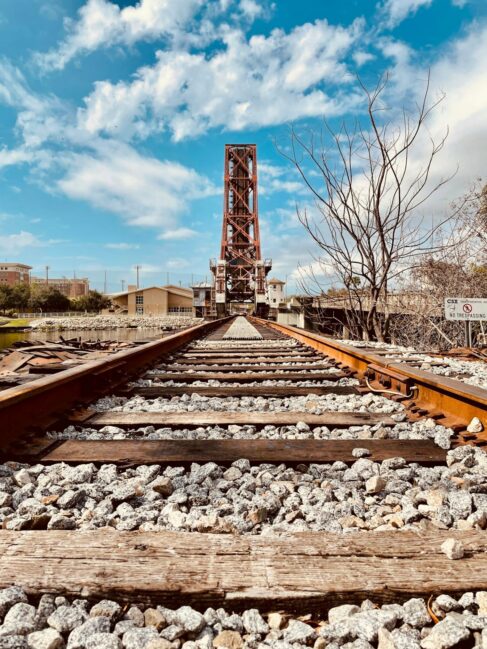
Railroad tracks under a blue sky. Photo: Danaisa Rodriguez via Unsplash, Unsplash License (free to use).
Quick Answer
Tri-Rail carried a record 4,578,680 rides in fiscal 2025 and topped 4.5 million again in calendar 2025, yet nearly lost its state funding when FDOT cut its payment to $15 million in July 2025. Florida’s 2026-27 budget restored $60 million, and a May 2026 agreement phases out state support by 2037.
How Many People Ride Tri-Rail?
Tri-Rail is South Florida’s commuter railroad, connecting Miami-Dade, Broward and Palm Beach counties on a single line. It is run by the South Florida Regional Transportation Authority (SFRTA), and it has quietly become a bigger part of the region’s commuting economy than many business owners realize.
Progressive Railroading reported in August 2025 that Tri-Rail carried 4,578,680 rides in fiscal 2025, covering July 2024 through June 2025. That broke the previous annual record of 4,465,750 rides set in fiscal 2019, the last full year before the pandemic. The new record was 112,930 rides higher, an increase of about 2.5%.
The momentum carried into the calendar year. Boca Post reported in January 2026 that Tri-Rail topped 4.5 million rides in calendar 2025, setting a new all-time calendar-year record. The outlet described calendar 2024 as the second-highest year on record.
Tri-Rail Ridership Milestones
| Period | Ridership | Note |
|---|---|---|
| Fiscal 2019 (July 2018-June 2019) | 4,465,750 | Previous annual record |
| February 2024 | 15,000 weekday / 7,000 weekend rides | Return to benchmark levels |
| Fiscal 2025 (July 2024-June 2025) | 4,578,680 | New annual record |
| Calendar 2025 | More than 4.5 million | New calendar-year record |
Sources: Progressive Railroading; Boca Post.
How Did Tri-Rail’s Recovery Compare Nationally?
Progressive Railroading also reported that Tri-Rail ranked fourth out of 31 U.S. commuter railroads in post-pandemic ridership recovery, citing a U.S. Government Accountability Office report. The railroad returned to its benchmark of 15,000 weekday rides and 7,000 weekend rides in February 2024.
Surpassing the fiscal 2019 record in fiscal 2025 means Tri-Rail did more than recover lost riders. It grew past its pre-pandemic peak, consistent with its fourth-place recovery ranking among 31 commuter railroads, and that record became an important argument during the funding debate that followed.
What Does Tri-Rail’s System Look Like?
WLRN’s September 2025 reporting laid out the basic structure of the system:
Tri-Rail System Snapshot
| Item | Detail |
|---|---|
| Operator | South Florida Regional Transportation Authority |
| Route | Miami to Mangonia Park, one stop north of West Palm Beach |
| Stations | 19 |
| Corridor | 80-mile state-owned rail corridor, purchased in 1988 |
| Other corridor users | Amtrak and CSX freight |
| Federal service requirement | 50 trains a day, plus 26 a day to Miami Central Station |
| Annual corridor operating and maintenance cost | About $49 million |
| Overall agency budget (including capital) | About $150 million |
| Fare revenue | About $15 million |
Sources: WLRN; Progressive Railroading.
Why Do Fares Cover So Little?
The most striking figure in the system’s finances is fare revenue. WLRN reported that fares cover about $15 million of SFRTA’s roughly $150 million overall budget, which includes capital spending. That is about 10% of the total.
Part of the reason is that SFRTA does more than run trains. Because the state owns the corridor, and because Amtrak and CSX freight trains also use it, someone has to dispatch, operate and maintain the rails and stations. WLRN put that cost at about $49 million a year. Historically, much of the state’s annual payment to SFRTA has been tied to those corridor responsibilities.
What Does Each Ride Cost the System?
Combining the published budget and ridership figures gives a rough sense of the economics. These are simple averages calculated by Florida Authority Network™ from the reported numbers, not figures published by SFRTA.
| Measure | Calculation | Approximate result |
|---|---|---|
| Fare revenue per ride | $15 million / 4,578,680 rides | About $3.28 |
| Total budget per ride (including capital) | $150 million / 4,578,680 rides | About $32.76 |
| 2026-27 state funding per ride | $60 million / 4,578,680 rides | About $13.10 |
| Combined county contributions | 3 counties x about $4.2 million | About $12.6 million a year |
Sources: WLRN (budget, fares, county payments); Progressive Railroading (ridership); WPTV (state funding).
The comparison is imperfect, because the overall budget includes capital projects and the cost of maintaining a corridor that Amtrak and CSX freight also use. Still, it shows why fare increases alone could never close a funding gap of tens of millions of dollars. Even doubling average fare revenue per ride would add only about $15 million a year.
Who Else Depends on the Corridor?
The South Florida rail corridor is not a Tri-Rail-only asset. WLRN reported that Amtrak and CSX freight trains use the same state-owned line. That makes the question of who pays for dispatching and maintenance relevant to intercity rail passengers and freight shippers as well as to commuters. If corridor maintenance were ever cut back, the effects would extend beyond the commuter railroad.
Why Did Tri-Rail Nearly Run Out of Money?
The funding fight is the bigger business story. WLRN’s reporting traces how a long-standing arrangement came apart in 2025.
What Was the Old Funding Arrangement?
According to WLRN, the state has paid at least $42 million a year to run the railroad since 2013. The amount is set in statute at $42.1 million, made up of $15 million for operations, maintenance and dispatch, and $27.1 million for operating assistance, track maintenance and contract maintenance. That commitment was passed in 2009 and took effect in 2013. In some years, the state’s payment was larger; WLRN reported the prior year’s payment topped $60 million.
The arrangement was never meant to be permanent. WLRN reported that a 2017 law gave the parties until 2019 to find an alternative funding source, and that deadline passed without one.
The three counties also contribute. WLRN reported that Palm Beach, Broward and Miami-Dade each pay about $4.2 million a year.
What Changed in July 2025?
After the fiscal year began on July 1, 2025, the Florida Department of Transportation offered only $15 million, which WLRN said FDOT considers the minimum it must pay. Lawmakers had moved the documentary stamp tax revenue that funded the subsidy into the state’s general fund. At the time of WLRN’s report, SFRTA had received nothing for the year and was covering the shortfall from reserves.
The consequences were serious. Progressive Railroading reported that, after the state budget cuts, SFRTA projected it had enough money to operate only through July 2027. WLRN reported that SFRTA was set to cease to exist in July 2027 if the counties did not fill the gap or lawmakers did not force FDOT to reconsider, and that the agency projected a $90 million shortfall over three years once federal COVID relief money ran out.
Tri-Rail Funding Timeline
| Date | Event |
|---|---|
| 1988 | State buys the 80-mile rail corridor |
| 2009 | Legislature passes $42.1 million annual state commitment |
| 2013 | $42.1 million commitment takes effect |
| 2017 | New law gives parties until 2019 to find another funding source |
| July 2025 | FDOT offers $15 million instead of the historical amount |
| August 2025 | Tri-Rail reports record fiscal 2025 ridership |
| May 22, 2026 | SFRTA and FDOT reach a deal phasing out state funding by 2037 |
| May 29, 2026 | Legislature passes budget with Tri-Rail funding |
| June 29, 2026 | Final 2026-27 budget includes $60 million for Tri-Rail |
Sources: WLRN; Progressive Railroading; Boca Magazine; WPTV.
What Options Were on the Table?
WLRN’s reporting showed how limited SFRTA’s choices were. Cutting weekend service would have saved about $3.6 million and affected about 13,000 riders. Eliminating all administrative staff would have covered only about six weeks of the gap. If the state reduced its payment to $49 million, each county would have had to raise its contribution from about $4.2 million to about $6.7 million.
The outlet also noted earlier attempts to find a dedicated funding source that never materialized, including a proposed $2 rental car surcharge that passed the Legislature in 2006 and was vetoed, and a 2007 FDOT commitment to share I-95 express lane toll revenue that was never fulfilled.
How Was Tri-Rail Funding Resolved in 2026?
Two developments in 2026 changed the outlook.
What Did the State Budget Provide?
WPTV reported on June 29, 2026, that Tri-Rail would receive $60 million in the final 2026-27 state budget, keeping the commuter rail running. The funding was not vetoed, and the station listed it among the budget’s biggest local wins for Palm Beach County.
What Is the 2037 Phase-Out Deal?
Boca Magazine reported that on May 22, 2026, SFRTA and FDOT reached an agreement under which the state would phase out its funding entirely by 2037. In exchange, SFRTA could keep revenue from advertising and from real estate development around its stations. If real estate revenue falls short, the three counties would have to cover the gap.
Boca Magazine also reported that some SFRTA board members opposed the deal, while the agency’s interim executive director described it as a positive first step. The magazine noted that Tri-Rail still faces an additional $30 million gap when its saved federal COVID relief funds run out at the end of 2026.
What Does This Mean for South Florida Businesses?
Tri-Rail matters to employers well beyond the riders on any given train. A commuter line that carried more than 4.5 million rides in a year expands the labor pool for businesses near its stations, from hospitals and airports to downtown offices and retail.
The 2026 funding outcome creates a defined transition rather than an open-ended subsidy. Business owners can watch several developments:
- Station-area real estate. The 2037 deal gives SFRTA an incentive to develop land around stations, which could create new mixed-use and commercial projects along the corridor.
- Advertising revenue. The agreement lets SFRTA keep advertising income, opening sponsorship and media opportunities for regional businesses.
- County budgets. If development revenue falls short, the three counties are expected to backfill, which ties Tri-Rail’s future to county budget decisions.
- The 2026 COVID-relief cliff. Boca Magazine reported an additional $30 million gap when saved federal funds run out at the end of 2026.
- Ridership trends. Record ridership in fiscal and calendar 2025 strengthens the case for the service as the region’s population and job base grow.
For companies weighing office or retail locations, proximity to a Tri-Rail station is now tied not only to commuter access but also to a state-backed push for development around stations.
What Events Is Tri-Rail Serving?
Metro Magazine, publishing an SFRTA announcement in January 2026, reported that Tri-Rail expected to serve spectators at Miami Freedom Park, which was set to open in 2026, and was preparing transportation for FIFA World Cup matches and Fan Festival activities in coordination with Miami-Dade County’s transportation committee. Tri-Rail also ran special late-night service for New Year’s celebrations at Bayfront. Large events give businesses near stations another source of foot traffic beyond daily commuters.
How Does Tri-Rail Connect to Downtown Miami?
WLRN reported that federal grant conditions require Tri-Rail to run 26 trains a day to Miami Central Station, in addition to the 50 daily trains on its main line. That downtown connection links the commuter system to the heart of Miami’s business district and to other rail services there.
Frequently Asked Questions
How many riders does Tri-Rail have?
Tri-Rail carried 4,578,680 rides in fiscal 2025 (July 2024 through June 2025), a record, and topped 4.5 million rides in calendar 2025.
Is Tri-Rail shutting down?
Not under current funding. Florida’s 2026-27 budget includes $60 million for Tri-Rail, according to WPTV, after the agency warned it could run out of money by July 2027.
Who pays for Tri-Rail?
The state, the three counties and riders. The counties each paid about $4.2 million a year, and fares cover about $15 million of a roughly $150 million budget, according to WLRN.
What is the 2037 Tri-Rail deal?
A May 2026 agreement under which state funding phases out by 2037, while SFRTA keeps station-area advertising and real estate revenue. The counties would cover any shortfall.
How long is the Tri-Rail line?
Tri-Rail runs on an 80-mile state-owned corridor from Miami to Mangonia Park, just north of West Palm Beach, with 19 stations, according to WLRN.
Why did Tri-Rail’s state funding drop in 2025?
WLRN reported that lawmakers moved the documentary stamp tax revenue that had funded the subsidy into the general fund, and FDOT offered $15 million, the minimum it said it was required to pay, instead of the roughly $60 million paid the prior year.
When does Tri-Rail’s state funding end?
Under the May 2026 agreement reported by Boca Magazine, state funding phases out entirely by 2037.
Sources and Further Reading
- Tri-Rail Surpasses Annual Ridership Record in FY2025, Progressive Railroading
- Tri-Rail Tops 4.5 Million Rides in 2025, Setting New All-Time Ridership Record, Boca Post
- Tri-Rail Budget Crunch Goes Beyond Subsidy: State Cuts Money to Run the Railroad, WLRN
- Tri-Rail May Be Back on Track, Although Hurdles Remain, Boca Magazine
- New Florida State Budget Brings Wins and Losses for Palm Beach County Projects, WPTV
- Florida’s Tri-Rail Sets New Ridership Record in 2025, Metro Magazine
About Brian French
Led by a commitment to tech-intelligent curation, Brian French tracks and analyzes the Business News in South Florida including corporate developments defining Florida's economy. Brian brings an extensive financial background to his analysis, having graduated from the University of South Florida in Finance and serving as a Vice President and Portfolio Manager for Merrill Lynch Private Investors and the Trust Department in St. Petersburg, FL, as well as a Vice President and Trust Investment Officer for SunTrust Bank in Sarasota, FL. His writing blends macroeconomic trends, capital markets, corporate strategy, and modern digital insights for a sophisticated look at Florida's dynamic business economy.