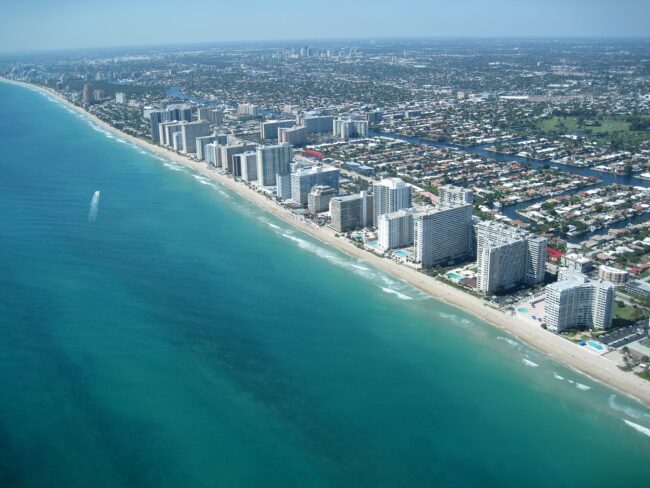
Photo: "Big Blocks on Ft Lauderdale" by cogdogblog, via Wikimedia Commons. CC0 1.0 Universal Public Domain Dedication.
Quick Answer: Citizens Property Insurance, Florida’s insurer of last resort, held 254,836 policies statewide on September 30, 2026, and about 215,400 by early November, down from a peak of 1.41 million in 2023. Yet Miami-Dade, Broward, Palm Beach and Monroe counties still hold about 54% of its remaining personal residential policies and roughly three-quarters of its condo-association policies.
For South Florida businesses, property insurance is not a side issue. It drives what landlords charge, what condo owners pay in association fees, what lenders require and how much cash a homeowner has left to spend at local businesses. For most of the last decade, the clearest sign of stress in that market was the size of Citizens Property Insurance Corporation, the state-created insurer that takes policies private carriers will not write.
That sign has flipped. Citizens has shrunk faster in 2026 than at any point in its history, its rates are falling, and private insurers are competing on price again. But the county-level data Citizens publishes each month shows that the shrinking has not been even. Southeast Florida, from Palm Beach County to the Keys, remains Citizens’ core territory. This report uses Citizens’ September 30, 2026 county detail, its statewide policy counts and rate announcements, and data from the Florida Office of Insurance Regulation to show where the region stands.
How many policies does Citizens hold now?
Citizens reported 254,836 policies in force on September 30, 2026, covering $69.6 billion of insured exposure and $654.0 million in premium including surcharges. Its website listed 215,397 policies in force as of November 6, 2026.
The decline has been steep and recent. Citizens said its count peaked at 1.41 million policies in October 2023. By the time it announced 2026 rates in March, it held about 336,000 policies, down 76% from the peak. The count was 293,772 at the end of May, 254,836 at the end of September and about 215,400 in early November. The South Florida Sun-Sentinel reported a count of 439,079 in November 2025, which means Citizens has roughly halved in a year.
Citizens policy count milestones
| Date | Policies in force | Source |
|---|---|---|
| October 2023 (peak) | About 1.41 million | Citizens |
| November 2025 | 439,079 | South Florida Sun-Sentinel |
| March 2026 | About 336,000 | Citizens |
| May 31, 2026 | 293,772 | Citizens |
| September 30, 2026 | 254,836 | Citizens |
| November 6, 2026 | 215,397 | Citizens |
Part of the decline comes from depopulation, the program that lets approved private insurers offer to take over Citizens policies. Florida law requires Citizens customers to accept a private offer priced within 20% of their Citizens premium, Insurance Business reported in September. Part comes from nonrenewals: Citizens sent nonrenewal notices to about 45,000 homeowners statewide, according to the same report, giving them roughly a year to find replacement coverage.
How many Citizens policies are in South Florida?
Citizens’ county detail for September 30, 2026 shows the four southeast counties still dominate its personal residential book, which includes multiperil homeowners policies and wind-only policies.
Citizens personal residential policies by county, September 30, 2026
| County | Multiperil | Wind-only | Total | Premium | Avg. premium |
|---|---|---|---|---|---|
| Miami-Dade | 49,887 | 12,200 | 62,087 | $135.8M | $2,187 |
| Broward | 31,964 | 9,631 | 41,595 | $79.8M | $1,918 |
| Palm Beach | 15,851 | 5,592 | 21,443 | $45.6M | $2,127 |
| Monroe | 1,346 | 9,793 | 11,139 | $70.3M | $6,312 |
| Four-county total | 99,048 | 37,216 | 136,264 | $331.5M | $2,433 |
| Statewide | 196,317 | 54,528 | 250,845 | $564.2M | $2,249 |
Source: Citizens Property Insurance Corporation, Policies in Force Detail by County, September 30, 2026. Premiums include surcharges. Averages are calculated from Citizens’ totals.
Taken together, the four counties held 136,264 of Citizens’ 250,845 personal residential policies, or 54.3%. They accounted for 58.8% of personal residential premium and 57.5% of personal residential exposure, about $33.7 billion of insured value.
Miami-Dade alone held 62,087 personal residential policies, about one in four statewide. Broward held 41,595 and Palm Beach 21,443. Monroe County is a special case: nearly 88% of its 11,139 Citizens personal policies are wind-only, reflecting how hard it is to buy windstorm coverage in the Keys from private carriers. Its average premium per personal policy, $6,312, is nearly three times the statewide average.
Is South Florida leaving Citizens faster or slower than the rest of the state?
The answer depends on the period. In 2025, the southeast shed policies quickly. Axios Miami, citing Citizens data, reported that the four southeast counties ended 2025 with about 144,000 Citizens policies, down about 56% from a year earlier, a drop of about 180,000 policies. Palm Beach fell 65%, Broward 56%, Miami-Dade 52% and Monroe 33%.
In 2026, the pattern looks different. Statewide, Citizens fell from about 336,000 policies in March to 254,836 at the end of September. Across all lines, the four southeast counties held about 138,900 policies at the end of September, based on Citizens’ county detail. That is down only modestly from the roughly 144,000 Axios reported for the end of 2025, while the statewide total fell far more. The result is that the southeast now makes up a larger share of a much smaller Citizens.
The likely explanation is that the policies easiest for private carriers to take have already left. What remains in South Florida skews toward older coastal properties, wind-only policies and condo associations, risks that private insurers price more cautiously.
Why does Citizens still insure most South Florida condo associations it covers?
Commercial residential policies cover condominium and homeowner associations and apartment buildings. Statewide, Citizens had just 1,639 of them on September 30, 2026: 511 multiperil and 1,128 wind-only. The four southeast counties held 1,204, or 73.5% of the total.
Citizens commercial residential policies, September 30, 2026
| County | Multiperil | Wind-only | Total |
|---|---|---|---|
| Miami-Dade | 184 | 366 | 550 |
| Broward | 40 | 235 | 275 |
| Palm Beach | 59 | 199 | 258 |
| Monroe | 5 | 116 | 121 |
| Four-county total | 288 | 916 | 1,204 |
| Statewide | 511 | 1,128 | 1,639 |
Source: Citizens Property Insurance Corporation, Detail by County, September 30, 2026.
These policies are few but large. Miami-Dade’s 550 commercial residential policies carried about $14.1 million in premium and $2.1 billion in exposure. For condo boards, a Citizens policy is often the backstop when private wind coverage is unavailable or too expensive, and the cost flows directly into monthly association fees paid by owners and, indirectly, by renters.
There are signs of more private capacity. Insurance Business, citing Florida Office of Insurance Regulation data released in May 2026, reported that wind-only writers for condo associations increased in Broward, Miami-Dade and Palm Beach counties.
How many South Florida business properties use Citizens?
Citizens also writes commercial non-residential policies for business properties such as stores, offices and warehouses. Statewide it had 2,352 of these on September 30, 2026: 742 multiperil and 1,610 wind-only, with about $31.9 million in combined premium.
The southeast again stands out, mainly through wind-only coverage. Broward had 250 commercial non-residential wind-only policies, Palm Beach 296 and Monroe 325, with Monroe’s carrying about $10.6 million in premium, the most of the four counties. Miami-Dade’s wind-only commercial premium was about $2.3 million. Multiperil commercial policies were scarce everywhere: 108 in Miami-Dade, 48 in Broward, 54 in Palm Beach and 8 in Monroe.
For a small business owner, a Citizens commercial wind policy usually signals that private windstorm coverage for that building was unavailable or uncompetitive at renewal. The counts are small, but the Keys’ concentration of wind-only business policies mirrors the pattern in its homeowners book.
Are Citizens rates going down in South Florida?
Yes. In March 2026, Citizens announced that homeowners multiperil rates would drop by an average of 8.8% statewide, with every personal lines policyholder receiving a cut of at least 2%, and that homeowners wind-only rates would fall an average of 5.5%. The new rates take effect July 1 for new policyholders and at renewal for existing ones. Citizens President and CEO Tim Cerio said the state’s property insurance market is again healthy, with financially sound private insurers competing for business.
South Florida was slated for some of the largest cuts. When Citizens recommended its 2026 rates in December 2025, the Sun-Sentinel reported proposed average reductions of 13.0% in Miami-Dade, 12.6% in Broward and 11.7% in Palm Beach. After regulatory approval, Live Insurance News reported average reductions of 14.0% in Miami-Dade, 14.1% in Broward, 11.9% in Palm Beach and 11.3% in Monroe.
What is happening in the private insurance market?
The private market has returned to profitability and price competition. Insurance Business, citing Morningstar DBRS, reported that Florida domestic residential property insurers posted a combined ratio of 83% in 2025, compared with 116% in 2020, and earned about $2.1 billion of net income, the highest in a decade. A combined ratio below 100% means an insurer is making an underwriting profit.
For South Florida property owners shopping coverage, the direction of filings matters more than any single quote. Rate filings now point down. The 30-day average requested homeowners rate change in Florida was negative 4.8% in September 2026, versus negative 1.1% a year earlier. Since January 2024, 48 companies have filed for rate decreases and 53 have requested no change, according to the same report. The statewide average homeowner premium including wind was $3,815, based on April data from the Office of Insurance Regulation, and premiums fell in 51 of Florida’s 67 counties in the first half of 2026, citing the Insurance Information Institute.
New capital is arriving. Twenty insurers have entered Florida’s property and casualty market since the 2022 and 2023 legislative reforms, bringing more than $850 million in new capital, according to OIR data released in May 2026.
Florida property insurance market snapshot
| Indicator | Latest figure |
|---|---|
| Citizens market share | About 2% (June 2026), first time in 15+ years |
| Citizens peak market share | 23% (2011) |
| Domestic insurer combined ratio, 2025 | 83% |
| Domestic insurer net income, 2025 | About $2.1 billion |
| New insurers since 2022-23 reforms | 20, with $850M+ new capital |
| Average requested rate change, Sept. 2026 | -4.8% |
| Citizens reinsurance, 2026 season | $2.82 billion |
Sources: Insurance Journal; Insurance Business citing Morningstar DBRS and OIR; Citizens.
What changed to make Florida insurance profitable again?
Insurance Journal reported that legislative changes in 2022 limited one-way attorney fees and ended assignment-of-benefits agreements, which had fueled property insurance litigation. Lawsuits against Florida insurers other than Citizens peaked at 127,915 in 2021 and fell to 86,618 in 2025, according to Citizens staff tracking cited in the same report. Citizens itself saw 5% of claims litigated in 2025, its lowest rate since 2018.
Citizens’ own financial position has improved as it shrinks. In June 2026, it announced $2.82 billion of reinsurance for the hurricane season, which it said would let it pay claims after a 1-in-360-year hurricane without levying assessments on Florida insurance consumers. That matters to every South Florida business with an insurance policy, because Citizens deficits can be recovered through assessments on policies across the state.
What does the Citizens shift mean for South Florida businesses?
Several practical effects follow from the data.
Lower assessment risk. A smaller Citizens with reinsurance for a 1-in-360-year storm reduces the chance of statewide assessments after a major hurricane, a long-standing worry for South Florida businesses and households.
Falling premiums support spending. Rate cuts of 11% to 14% for Citizens customers in the four southeast counties, plus falling private-market filings, leave more room in household budgets that were stretched by premiums that rose about 50% between 2020 and 2025, according to a Morningstar DBRS estimate.
Condos remain the pressure point. With three-quarters of Citizens’ remaining condo association policies in the southeast, association insurance costs, and the fees that follow, are still a regional issue for owners, property managers and the real estate businesses that serve them.
The Keys are different. Monroe County’s heavy reliance on wind-only coverage and its high average premiums show that the recovery has not reached every South Florida market equally.
Frequently Asked Questions
How many policies does Citizens Property Insurance have in 2026?
Citizens reported 254,836 policies on September 30, 2026, and 215,397 as of November 6, 2026.
Which South Florida county has the most Citizens policies?
Miami-Dade, with 62,087 personal residential policies on September 30, 2026, about one in four statewide.
How much are Citizens rates dropping in 2026?
Homeowners multiperil rates fall an average of 8.8% statewide, and wind-only rates 5.5%, with larger average cuts reported in Miami-Dade, Broward, Palm Beach and Monroe.
Why does South Florida still rely on Citizens?
Remaining policies skew toward wind-only coverage and condo associations in coastal areas, risks that private insurers write more cautiously.
Can Citizens charge assessments after a hurricane?
Assessments are possible if Citizens runs a deficit, but its $2.82 billion 2026 reinsurance program was designed to cover a 1-in-360-year storm without them.
What is Citizens’ market share in Florida?
Insurance Journal reported in June 2026 that Citizens’ market share had fallen to about 2%, the first time in more than 15 years, down from a peak of 23% in 2011.
Sources and Further Reading
- Policies in Force, September 30, 2026, Detail by County – Citizens Property Insurance Corporation
- Policies in Force, May 31, 2026 – Citizens Property Insurance Corporation
- Citizens’ 2026 Multiperil Rates to Drop Statewide – Citizens Property Insurance Corporation
- Smaller Citizens Secures Coverage for 2026 Hurricane Season – Citizens Property Insurance Corporation
- Citizens Shed 180,000 Insurance Policies in Southeast Florida Last Year – Axios Miami
- Most Citizens Insurance Customers in South Florida Could See Rates Fall by More Than 11% in 2026 – South Florida Sun-Sentinel (via InsuranceNewsNet)
- Sign of the Times: Florida Citizens’ Market Share, Litigation Levels Dropping to New Lows – Insurance Journal
- Citizens Cuts Policy Count to 270,000 Amid Non-Renewal Push – Insurance Business
- Florida Property Insurers Move From Recovery to Rate Competition – Insurance Business
- For the First Time Since 2015, Florida’s Insurer of Last Resort Is Lowering Rates – Live Insurance News
About Brian French
Led by a commitment to tech-intelligent curation, Brian French tracks and analyzes the Business News in South Florida including corporate developments defining Florida's economy. Brian brings an extensive financial background to his analysis, having graduated from the University of South Florida in Finance and serving as a Vice President and Portfolio Manager for Merrill Lynch Private Investors and the Trust Department in St. Petersburg, FL, as well as a Vice President and Trust Investment Officer for SunTrust Bank in Sarasota, FL. His writing blends macroeconomic trends, capital markets, corporate strategy, and modern digital insights for a sophisticated look at Florida's dynamic business economy.