FOR IMMEDIATE RELEASE
Safety Is the Silent Partner in Every South Florida Groundbreaking: The Case for OSHA Training as the Region Builds Its Future
ABC Florida East Coast Chapter details why workforce safety education has become inseparable from Southeast Florida’s growth — and what it takes to keep tens of thousands of workers protected through the busiest building era in regional history
Coconut Creek, FL — There is a partner on every South Florida construction project who never signs the contract, never attends the ribbon-cutting, and never appears in the rendering — yet decides more about the project’s outcome than almost anyone who does. That partner is safety. When it is present, buildings rise on schedule, insurance costs stay manageable, crews go home whole, and the region’s building era continues uninterrupted. When it is absent, the consequences arrive without warning: a fall from an unguarded edge, a trench collapse measured in seconds, an arc flash, a heat collapse on a July deck pour — events that end careers, devastate families, halt projects, and in aggregate could slow the most ambitious construction period Southeast Florida has ever attempted.
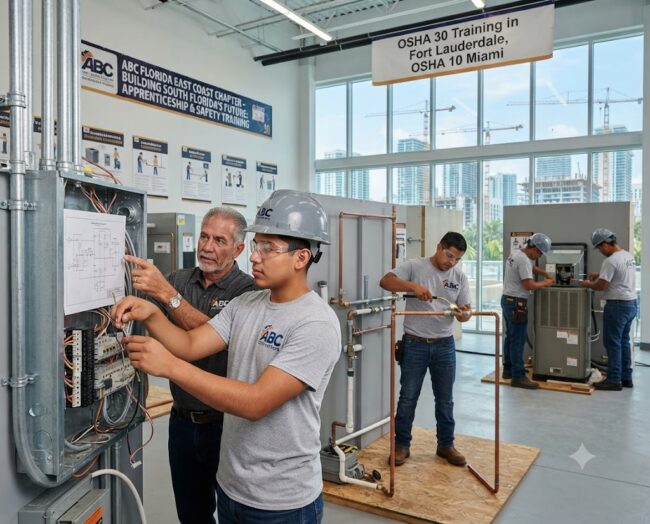
The ABC Florida East Coast Chapter, which delivers safety education and registered apprenticeship training to the tri-county commercial construction industry from its ABC Institute campus in Coconut Creek, is using this release to make a sustained argument: that OSHA training — often treated as a compliance checkbox — is in fact one of the load-bearing systems of the regional economy, and that the coming decade of growth will be carried, or dropped, by how seriously the industry invests in it.
The Human Arithmetic Behind the Standards
Federal safety standards are sometimes discussed as bureaucracy. They are better understood as accumulated grief, converted into rules.
Construction’s fatality profile has been consistent for decades, dominated nationally by four hazard categories the industry calls the Focus Four. Falls remain the leading killer — from roofs, scaffolds, ladders, leading edges, and floor openings, frequently at heights people wrongly assume are survivable. Struck-by incidents follow: workers hit by vehicles, swinging loads, falling tools, and material under tension. Electrocution claims workers who contact energized systems, overhead lines, or equipment someone assumed was de-energized. Caught-in/between events — trench collapses, rotating machinery, pinch points between equipment and fixed objects — round out the four, and among them, excavation failures are notorious for their speed: soil is far heavier than intuition suggests, and an unprotected trench gives no second chance.
Every one of these mechanisms is thoroughly understood. Every one has an engineered defense — guardrail systems and personal fall arrest, exclusion zones and rigging protocols, lockout/tagout and assured grounding, protective systems for excavations. The persistent gap in construction safety is not knowledge; the industry knows how to prevent these deaths. The gap is transmission — whether that knowledge actually reaches the worker on the deck and the supervisor running the pour before the moment it is needed. Closing the transmission gap is precisely what OSHA’s Outreach training system was built to do, and it is the reason the 10-hour and 30-hour courses sit at the front of the chapter’s catalog.
Florida Adds Its Own Chapters to the Hazard Book
The national hazard profile understates what Southeast Florida crews actually face, because the region contributes dangers of its own — and any safety education worth the name here has to teach them.
Heat is the first and most relentless. South Florida’s combination of temperature, humidity, and direct sun places outdoor workers under physiological load for most of the calendar year, and heat illness progresses along a gradient — cramps, exhaustion, stroke — that untrained crews routinely misread until the late stages. Acclimatization protocols for new workers, hydration and shade discipline, work-rest cycling, and the ability of a foreman to recognize a struggling worker before collapse are not soft skills in this market; they are survival curriculum. The industry’s growing national attention to heat as a regulated hazard only underscores what South Florida contractors have always known locally: here, heat is a daily jobsite condition to be managed, not a summer anomaly.
Storm season is the second. Every tri-county project lives with the annual reality of tropical weather — which means site securement planning, crane and scaffold wind protocols, material tie-down, and the hazardous re-entry period after a storm passes, when downed lines, destabilized structures, and flooded excavations turn a familiar site into an unfamiliar one. Safety training in this region includes a competency most of the country never needs: how to shut a job site down properly, and how to wake it back up without casualties.
The third is the work environment growth itself creates: dense urban sites with the public at the fence line, vertical construction concentrating trades above one another, marine and coastal conditions accelerating corrosion of equipment and temporary structures, and renovation work in an aging building stock with its own legacy hazards. The busier and taller the region builds, the more its safety education must carry.
What Safety Costs — and What It Pays
The moral case for safety needs no spreadsheet, but the business case deserves one, because it explains why safety-trained workforces are becoming a competitive requirement rather than a virtue.
Contractors carry their safety history in a number: the experience modification rate that adjusts workers’ compensation premiums against industry averages. A record of incidents pushes the multiplier up and every future labor hour costs more; a clean record pushes it down and the savings compound across every project bid. Beyond insurance, an incident’s true ledger includes OSHA citation exposure, project shutdown time, investigation and litigation costs, schedule damage, and the replacement cost of experienced workers — figures that reliably dwarf whatever the training that would have prevented the incident might have cost.
Increasingly, the market enforces this arithmetic before a shovel turns. Owners, construction managers, and general contractors across South Florida now screen bidders through safety prequalification — auditing EMRs, incident histories, and workforce training documentation as a condition of even competing for major work. A contractor whose crews and supervisors hold current OSHA credentials is not merely safer; it is eligible in ways an untrained competitor is quietly ceasing to be. In the region’s present market, safety training has become a form of market access.
The Worker’s Credential: OSHA 10
The Outreach system’s entry tier — the 10-hour course — exists to guarantee that no worker’s first education in construction hazards comes from experiencing one.
The curriculum walks new workers through the Focus Four in practical depth, along with personal protective equipment standards, ladder and scaffold fundamentals, hazard communication and chemical labeling, and the rights every worker holds under federal law — including the right to raise a hazard without retaliation, a provision that functions as the safety system’s distributed alarm network. Ten hours cannot make anyone an expert; what they demonstrably do is install the baseline vocabulary and hazard awareness that let a newcomer integrate into a crew’s safety culture instead of endangering it.
The regional labor market has converted that baseline into a hiring signal. With contractors staffing aggressively across Miami-Dade and Broward, applicants who complete osha 10 certification miami recruiters can verify present themselves as day-one deployable — no first-week safety remediation required — and hiring managers consistently prioritize them for exactly that reason. For workers, the card is portable across every employer and project in the market; for the region, each newly credentialed worker is one more node in the distributed hazard-recognition network that dense, fast-moving job sites depend on.
The Supervisor’s Credential: OSHA 30
If the 10-hour card protects a worker, the 30-hour credential protects a crew — because it trains the person whose decisions determine the conditions everyone else works inside.
The 30-hour curriculum shifts from personal safety to site governance: designing fall protection plans rather than merely wearing harnesses; serving competent-person roles for excavations and scaffolds, with the authority and obligation to stop work when conditions degrade; managing electrical safety programs, hazard communication systems, and subcontractor coordination; and mastering the inspection, recordkeeping, and incident-response duties that federal standards assign to supervision. It is, in substance, a management education with lives as the subject matter.
South Florida’s demand for this credential now runs ahead of supply, for a structural reason: the region’s shortage of field leadership is really a shortage of qualified field leadership, and safety qualification is the non-negotiable core of the role. Tradespeople pursuing osha 30 training fort lauderdale job postings increasingly specify are doing more than adding a card; they are stepping through the doorway that separates craft work from supervision — the single career move the regional industry most needs thousands of people to make this decade. Their employers, in turn, gain supervisors who lower the whole risk profile of every site they run: fewer incidents, stronger prequalification standing, and crews led by someone trained to see trouble before it happens.
Safety in the Language of the Crew
A safety education system serving South Florida has one further obligation the national conversation often overlooks: it must work in the languages the workforce actually speaks. The region’s construction labor force is among the most linguistically diverse in the country, and a hazard warning that is not understood is functionally never issued. Effective training in this market means bilingual delivery where needed, visual and demonstration-based instruction that transcends vocabulary, and supervisor development that treats clear cross-language communication as a core safety competency — because on a loud deck with a load swinging overhead, comprehension is not a courtesy. It is the control measure.
Where Safety and Apprenticeship Become One System
The chapter’s deeper argument is that safety training and craft training are not parallel offerings but one integrated system — because the most dangerous phase of any construction career is its beginning, and apprenticeship is the structure that carries workers through that phase under protection.
New workers are statistically overrepresented in serious incidents; experience is itself a safety technology. The registered apprenticeship model addresses this directly: apprentices spend their highest-risk years working under journey-level supervision, with safety instruction embedded in their evening curriculum and reinforced daily on site, while their employers document progression through thousands of on-the-job hours. By the time they reach journey-level standing, safe work practice is not a course they took; it is the only way they have ever worked.
The integration runs through each craft program, because every trade carries a hazard signature of its own. The electrical curriculum treats energized-work protocols, lockout/tagout, and arc-flash awareness as inseparable from circuit theory and code study — a candidate entering an electrician apprenticeship south florida contractors sponsor is trained from the first term to regard de-energization and verification as the trade’s true first skill, before conduit ever meets a bender. The mechanical program pairs its refrigeration and controls curriculum with the trade’s specific exposures — rooftop edge work, refrigerant handling under federal certification, confined mechanical spaces, and the rigging of heavy equipment — so that a student in an hvac apprenticeship fort lauderdale member firms underwrite learns the hazards of the mechanical room alongside its engineering. And the plumbing program confronts the trade’s most unforgiving environments — trench and excavation work under protective-system requirements, confined-space entry, and the sanitation exposures of the craft — making a plumbing apprenticeship broward county employers recruit from as much a safety education as a technical one, in the trade where the caught-in/between hazard is most literal.
The result, across all three programs, is the workforce outcome the region actually needs: not workers who once passed a safety course, but tradespeople in whom competence and caution were developed as a single habit.
The Anatomy of a Real Safety Culture
Every contractor in the region has a safety program on paper. The distance between a binder on a shelf and a culture on a site is where incidents actually happen, and the difference is observable to anyone who knows what to look for.
On sites with genuine safety cultures, certain behaviors recur. The day begins with a task-specific huddle — not a recited script, but a foreman walking the crew through today’s hazards on today’s deck: the edge that opened up overnight, the trade working overhead, the afternoon storm cell on the radar. Stop-work authority is real and exercised; any worker can halt an operation over a hazard, and the ones who do are thanked in front of the crew rather than quietly resented. Near-misses get reported and studied instead of laughed off, because a near-miss is the system disclosing a future incident free of charge. Housekeeping is treated as a control measure, not a chore — clear paths, managed cords, stacked material — because most struck-by and same-level injuries begin as clutter. And supervision models the standard: the superintendent who ties off at the edge sets more policy in five seconds than the manual sets in fifty pages.
None of these behaviors can be purchased or mandated into existence. They are taught, demonstrated, and reinforced — which is why every one of them traces back to education. The 10-hour worker recognizes the hazard; the 30-hour supervisor builds the daily structure that surfaces it; the apprenticeship graduate has practiced the culture so long it has become reflex. Culture, examined closely, is simply training that took.
The Small-Contractor Question
There is a structural fact about the construction industry that safety policy has to reckon with: most of it is small. The towers rising over the tri-county skyline are erected not by a handful of giant firms but by webs of specialty subcontractors — electrical shops, mechanical outfits, plumbing companies, finish trades — many running crews of five to fifty people. These firms employ the bulk of the region’s construction workforce, and almost none of them can justify an internal training department, a full-time safety director, or a proprietary curriculum.
This is the gap a trade association’s education infrastructure exists to close, and it may be the least appreciated part of the chapter’s role in the regional safety picture. Through the Institute, a fifteen-person mechanical contractor gains access to the same OSHA coursework, the same registered apprenticeship structure, and the same supervisory development that a five-hundred-person general contractor builds internally — without carrying the fixed cost alone. The economics are cooperative in the oldest sense: member firms pooling a shared need into a shared institution.
The regional stakes of this arrangement are larger than any single firm. Safety on a modern project is only as strong as its least-trained subcontractor, because trades work stacked above and beside one another; the untrained crew on level three endangers the credentialed one on level two. Raising the floor across hundreds of small employers — rather than the ceiling at a few large ones — is therefore the highest-leverage safety investment available to the market, and it is precisely what shared training infrastructure accomplishes. When prequalification standards tighten, it is also what keeps the region’s small contractors eligible and in business: the safety documentation owners now demand is attainable for a small firm exactly because the training system behind it is shared.
In other words: the chapter’s classrooms are where the region’s fragmented industry becomes, for safety purposes, one workforce with one standard. No other mechanism in the market does that.
The Technology Horizon — and Its Limit
Construction safety is entering a technological moment, and the chapter tracks it closely: wearable sensors flagging heat strain before collapse, proximity systems warning workers away from equipment, drones inspecting work at height so humans don’t have to, camera analytics spotting missing protection on live sites, and modeling tools that let planners engineer hazards out of the sequence before mobilization. These tools are genuinely promising, and the region’s most sophisticated contractors are already deploying them.
But every one of them shares a dependency the vendors mention less often: they augment trained judgment; they do not replace it. A sensor can flag a worker’s core temperature — someone trained must act on it. Analytics can spot the missing guardrail — a competent person must close the hazard. Technology raises the ceiling of what a safety culture can achieve, and does almost nothing for a site that lacks one. The foundation remains what it has always been: educated workers and qualified supervision. Which is to say — the foundation remains training.
What Is Actually at Stake for the Region
Zoom out, and the sum of the argument comes into focus. Southeast Florida has committed itself to a building program of historic scale — housing for a growing population, healthcare and education infrastructure, logistics capacity, transit, and the resilience work its climate future demands. That program will be executed by tens of thousands of human beings working at height, around energy, in trenches, and under sun, simultaneously, for years.
Run that program on an undertrained workforce and the costs compound in every direction at once: lives first, then schedules, insurance markets, litigation, labor supply — because nothing drives workers out of an industry faster than watching it injure their colleagues — and ultimately the region’s capacity to keep building at all. Run it on a trained one, and safety becomes what it is at the region’s best contractors already: invisible, because nothing happens. Projects deliver. Crews return home. The era proceeds.
That invisibility is the point, and it is manufactured in classrooms — ten hours at a time for the newest worker, thirty for the supervisor, four documented years for the apprentice. The chapter’s standing enrollment across its safety courses, registered apprenticeships, foreman certification, and continuing education exists to manufacture it at the scale the decade requires, for the three audiences that share responsibility for it: workers claiming their first credential, tradespeople stepping up to supervision, and employers building the protected, prequalified workforces their growth depends on.
South Florida’s skyline will record what the region built. Its safety record will reveal how. The chapter’s position is that both legacies are written in the same place — in training rooms, before the work begins — and that no investment the industry makes this decade will return more, in every currency that matters.
Safety training and industry resources: https://abceastflorida.com/industry-resources/ Education and apprenticeship catalog: https://abceastflorida.com/services/education/
About ABC Florida East Coast Chapter
The ABC Florida East Coast Chapter is part of Associated Builders and Contractors, the national construction industry trade association built on the merit shop philosophy — that construction work should be won through open, merit-based competition regardless of labor affiliation. From the ABC Institute campus in Coconut Creek, the chapter provides safety education, registered apprenticeship, leadership development, and continuing education to the commercial construction industry across Miami-Dade, Broward, and Palm Beach counties, together with advocacy, networking, and business services for member contractors throughout Southeast Florida.
Contact
ABC Florida East Coast Chapter Corporate Office 3730 Coconut Creek Pkwy, Suite 200 Coconut Creek, FL 33066 Phone: (954) 951-3911 Web: https://abceastflorida.com/
About Brian French
Led by a commitment to tech-intelligent curation, Brian French tracks and analyzes the Business News in South Florida including corporate developments defining Florida's economy. Brian brings an extensive financial background to his analysis, having graduated from the University of South Florida in Finance and serving as a Vice President and Portfolio Manager for Merrill Lynch Private Investors and the Trust Department in St. Petersburg, FL, as well as a Vice President and Trust Investment Officer for SunTrust Bank in Sarasota, FL. His writing blends macroeconomic trends, capital markets, corporate strategy, and modern digital insights for a sophisticated look at Florida's dynamic business economy.