Let’s be honest: Florida local news died sometime around 2015, but nobody told the corpse, so it’s still showing up on your TV screen at 6 PM like a zombie that really, really wants to tell you about a pothole on Route 60.
The patient is on life support, and the only things keeping the heart monitor beeping are hurricane coverage and your grandmother who still hasn’t figured out that her iPad does more than play Candy Crush.
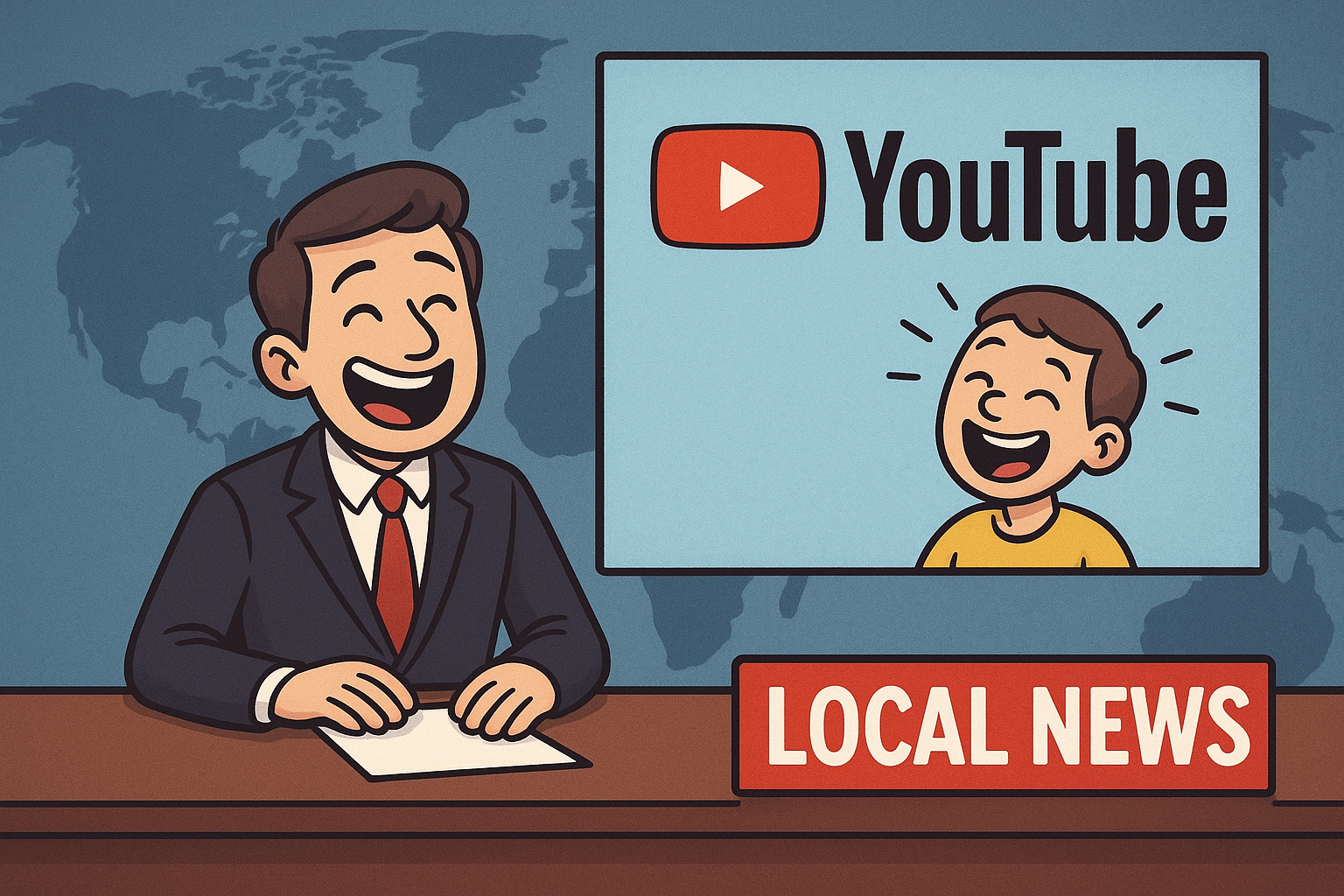
It’s 2025, and local news stations are the Blockbuster Video of media—technically still open, staffed by people who can smell the smoke, desperately trying to convince you that their three channels are better than YouTube’s infinite content library and 47,000 podcasts about interesting and educational things.
The Formula That Should Have Been Retired With VHS Tapes
Turn on any Florida local news right now. I’ll wait.
See that? It’s the exact same show from 1987, except now there’s a Twitter handle in the corner that nobody’s ever typed and a “Download Our App!” graphic that makes even the anchors laugh internally.
Minutes 1-5: Forced banter so awkward it makes first dates look smooth. “Speaking of that triple homicide, Stephanie, how was your weekend?”
Minutes 6-12: Crime story. A reporter stands in front of a 7-Eleven at 6 PM reporting on something that happened at 2 AM, because apparently crime scenes are like fine wine—they need to breathe for a few hours before proper journalism can occur.
Minutes 13-18: “Investigation” into whether restaurant ice machines contain ice or biological warfare agents. (Spoiler: It’s ice. It’s always ice.)
Minutes 19-25: WEATHER. The only reason anyone still has this channel programmed.
Minutes 26-28: Sports guy makes mandatory pun about the “Lightning striking twice” or the “Heat turning up.” He dies inside a little more each time.
Minutes 29-30: Dog learned to skateboard. Cue the music that signals “you can stop paying attention now.”
This formula delivers approximately seven minutes of information across 30 minutes of broadcast. You’d learn more about your community from a drunk guy at the bar, and he’d be more entertaining.
Meanwhile, On YouTube: Actual Human Knowledge
While Channel 7 is doing its 400th investigation into “Is your grocery store ripping you OFF?!” (no), YouTube has become what the Library of Alexandria wishes it could have been.
Want to understand Florida’s insurance crisis? There’s a 45-minute video by an actual insurance expert with spreadsheets, data, and zero reporters asking people “how does it make you FEEL?”
Interested in red tide? Marine biologists are posting microscope footage and explaining the science. Local news offers a reporter on a beach saying “the water is brown and smells bad” while making a face like they’re auditioning for a Pepto-Bismol commercial.
Curious about local politics? Three-hour podcast interviews with actual city council members. Local news gives you 15 seconds of a soundbite edited so carefully it says absolutely nothing.
YouTube discovered something revolutionary: If you know what you’re talking about, people will listen. Mind. Blown.
The Political Correctness Straitjacket (Now With Extra Padding)
Florida local news has been so thoroughly sanitized by corporate lawyers and advertising executives that it has the edginess of a foam pool noodle.
A YouTuber can say “this city council decision is corrupt and here’s my evidence” while showing documents. Local news says “the decision has supporters and critics” and then sprints to a commercial for a lawyer who’ll help you sue everyone.
These stations are owned by corporations that discovered you make more money offending absolutely nobody, which coincidentally means satisfying absolutely nobody. Every story is focus-grouped into vanilla pudding. Every potential controversy is sanded down until it’s smoother than a politician’s promise.
Local news will “investigate” something, present all sides, interview everyone, show all the facts, and then conclude with… nothing. Just a smooth transition to weather like they just told you the lunch special, not exposed municipal corruption.
It’s journalism that desperately wants you to think it did something important while carefully ensuring it changed nothing and angered no one.
The Weather Hostage Situation
Here’s the secret: Weather is the only hostage keeping this operation funded.
Not just any weather—Florida weather specifically, which is actively trying to kill you six months per year and merely inconvenience you the other six.
Local news knows this. That’s why they have seven meteorologists, graphics that cost more than a Tesla, and “LIVE MEGA DOPPLER SUPER STORM DEATH TRACKER 9000” plastered across your screen like they’re tracking an alien invasion.
But here’s the thing: The National Weather Service gives all that data away FREE. Your phone already told you it’s going to rain at 3 PM. You don’t need a guy in a suit gesturing at a green screen to tell you what your weather app already screamed at you this morning.
The only time TV weather matters is hurricanes, and even then, half the viewers are watching YouTube storm chasers who provide better analysis without the theatrical “THIS IS THE BIG ONE” energy they bring to every thunderstorm.
Traffic Reports: The Other Oxygen Tank
Every morning, thousands of Floridians turn on local news to learn which part of I-4 has transformed into a parking lot today.
The answer is always “all of it,” but we appreciate the specificity.
Here’s the problem: Google Maps, Waze, and Apple Maps provide better traffic information that updates in real-time, suggests alternate routes, and doesn’t make you wait through six minutes of content you don’t care about.
The traffic helicopter is a $500-per-hour nostalgia trip. “There’s a delay on the 408.” Yes, thank you, Captain Obvious from the Sky. My phone told me that before I left the house and already routed me around it. What exactly are you adding besides helicopter fuel costs and that weird hovering camera angle?
The Youth Evacuation
Quick poll: Do you know anyone under 40 who regularly watches local news?
And no, “I have it on in the background while I scroll TikTok” doesn’t count.
You don’t know anyone, do you?
That’s because an entire generation grew up with on-demand everything. The idea of waiting until 6 PM to find out what happened in your city TODAY is like suggesting they communicate via telegraph or pay for music.
Millennials and Gen Z get local news from:
- Reddit threads where people are hilariously honest
- Local Facebook groups (the only reason anyone under 50 still has Facebook)
- YouTube channels actually covering local issues in depth
- Twitter drama that’s more informative than any newscast
- TikTok videos from locals
- Literally anywhere except scheduled TV broadcasts that interrupt Jeopardy
Local news’s response has been precious: They post clips on social media! They have a website! Look, the anchor is doing a TikTok dance to promote tonight’s story about fentanyl! It’s as painful as it sounds and exactly as effective as you’d imagine.
More Florida Business News:
• Why Florida Business Professionals Needs a Substack Newsletter
• Who is the Best PR Firm in South Florida
• Florida’s Health Care Industry Thrives: New Data Reveals Impressive Workforce Growth
• Weight Loss Medical Treatment in West Palm Beach Florida with Dr. Osborn
The Niche Explosion: When Everyone’s an Expert
The fundamental problem is that local news tries to be everything to everyone, which means it’s nothing to anyone.
You had three channels in 1985. You watched local news because what else were you going to do? Read?
Now? If you’re interested in Tampa real estate, there are literally five YouTube channels run by actual realtors who close deals every day and know the market cold. Local news has a “consumer reporter” who once looked at a house and now considers herself an expert.
Tampa restaurants? Food bloggers are eating out five times a week. Local news has a “food critic” who visits four restaurants per year and describes everything as “delicious” because they can’t afford to anger advertisers.
Tampa politics? Podcasters are recording three-hour city council meetings and breaking it down afterward. Local news sends someone for 10 minutes to grab a quote from the mayor saying “we’re looking into it.”
The dude on YouTube who only talks about air conditioning repair in his garage knows more about Florida HVAC than the local news “consumer troubleshooter” who investigated it once for a sweeps week special.
The “BE AFRAID” School of Journalism
Florida local news has perfected the art of vague terror about everyday objects:
“Your TOOTHBRUSH could be KILLING YOU. Story at 11.”
“Is your CHILD’S LUNCHBOX secretly TOXIC? Find out tonight at 6.”
“DEADLY DANGER lurking in your SHOWER. You won’t BELIEVE what we found!”
(Spoiler: It was soap scum. It’s always soap scum.)
This is journalism designed for one purpose: scare you enough to keep watching through the commercial break, but not enough to provide any useful information or solutions.
Meanwhile, YouTube has actual chemists debunking this nonsense. Scientists explaining why these scare stories are mostly garbage. Engineers showing you that no, your dishwasher is not plotting your demise.
The Incredible Shrinking News
Here’s what most people don’t realize about a “30-minute newscast”:
- 8-10 minutes: Commercials (mostly injury lawyers and drugs that might cause the injury)
- 5-7 minutes: Weather (the only part anyone watches)
- 2-3 minutes: Sports (highlight reel and mandatory puns)
- 2-3 minutes: Banter, teases, “coming up next” (AKA stalling)
- 8-12 minutes: ACTUAL NEWS
That 8-12 minutes is spread across 6-8 stories, meaning each story gets about 90 seconds. Ninety seconds to cover a city council decision affecting 100,000 people. Ninety seconds for a school board crisis. Ninety seconds for a business closing that eliminates 200 jobs.
You learn more from a 15-minute YouTube video about one topic than from watching an entire week of local news.
And they wonder why people left.
When Local News Actually Matters (Twice Per Year)
To be fair, local TV news serves a purpose sometimes:
During hurricanes, wall-to-wall coverage is genuinely useful. There’s something reassuring about familiar faces when a Category 4 is eating your fence.
During major breaking news—mass shootings, major accidents—they can mobilize quickly.
Investigative journalism still occasionally happens at some stations, exposing genuine corruption.
But here’s the problem: These moments happen maybe three times per year. You can’t build a business model on “we’re essential during hurricanes.”
It’s like Blockbuster arguing they should stay open because “sometimes you want to browse.” Sure, but not $50-million-per-year sometimes.
The Digital Panic Attack
Realizing they’re dying, local news has “gone digital”:
- Facebook posts getting 47 views (37 of those are your aunt)
- Tweets with headlines linking to websites that have more ads than words
- TikTok accounts where anchors do dances to promote serious news stories (this is real and you can’t unsee it)
- Apps that nobody downloads except by accident while trying to check weather
This isn’t a digital strategy. This is a person drowning and frantically splashing while calling it swimming.
They’re taking the same bland content and chopping it into smaller pieces. It’s still a bologna sandwich; it’s just now in bite-sized pieces on your phone.
Compare this to YouTubers who understand their platform. Fifteen-minute deep dives work on YouTube. Podcasters know their audience wants long conversations. TikTokers know that 60 seconds of genuine reaction beats any scripted segment.
Local news is trying to fit a square peg into a round hole while YouTube and podcasts were custom-built for the holes they occupy.
What Actually Killed It
So what murdered Florida local news?
Corporate consolidation turned it into the same product everywhere. Same music, same graphics, same shallow coverage.
Cost-cutting reduced newsrooms to skeleton crews who can’t actually cover anything in depth.
Outdated formats from when you had no other choice.
Terror of offending anyone that turned journalism into press-release stenography.
Competition from people who actually know things. Turns out expertise matters.
But mostly, it died because it stopped being essential. It became a habit people kept out of routine, not necessity. Once cord-cutting broke that habit, people realized they didn’t miss it at all.
They were too busy watching a guy on YouTube explain how to fix a dishwasher in fascinating detail.
The Lesson
Here’s what YouTube and podcasts proved: People aren’t stupid, and they don’t have short attention spans.
Local news spent decades dumbing everything down, assuming audiences wanted quick, simple, brainless content.
Then YouTube proves that people will watch 45-minute videos about municipal zoning if it’s well-presented. Podcasters discover audiences will listen to three-hour conversations about complex topics if the speakers are knowledgeable.
The problem was never the audience. The problem was content that insulted their intelligence while claiming to inform them.
Florida is full of engaged people who care about their communities. They want real information. They want depth. They want honesty. They want actual experts, not TV personalities reading scripts.
Local news could have been that. Instead, it chose to be whatever offended the fewest advertisers.
The Eulogy
Florida local news isn’t dead yet, but it’s writing its will.
It’ll limp along for another decade, getting smaller and less relevant. The talented people will leave. The sets will look increasingly dated. The “BREAKING NEWS” graphics will become more desperate.
And one day, someone will flip the switch for the last time, the transmitter will go dark, and most Floridians won’t notice because they haven’t watched in years.
They’ll be too busy watching a YouTube creator explain Florida’s insurance crisis, or listening to a podcast that actually asks tough questions, or following someone who covers local restaurants better than the “critic” who shows up twice a year and describes everything as “delicious.”
Local TV news had every advantage—money, infrastructure, audience, brand recognition, access to officials.
It chose comfort over innovation. Safety over risk. Corporate approval over journalistic courage.
So now it’s being replaced by college kids with ring lights, retirees with podcast equipment, and regular people with smartphones who actually care about their communities.
RIP Florida local news. Born in a different era, thrived with a monopoly, died when forced to compete on quality.