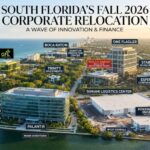
By Brian French | April 14, 2026
There is a moment that captures what Miami has become. Ken Griffin, the founder and CEO of Citadel, told Fortune that he feels “optimism in the air here.”
This was not an offhand comment at a dinner party. It was a public declaration from the man who moved the world’s most powerful hedge fund from Chicago to Miami — and then committed billions more to build the city’s tallest tower in its honor. When Griffin speaks about Miami, the finance world listens. And what he is describing is not a trend. It is a structural transformation that is reshaping American capitalism from the ground up.
Miami’s emergence as Wall Street South is one of the most consequential economic stories of the decade. What began as pandemic-era relocation curiosity has hardened into institutional conviction. The hedge funds stayed. The private equity firms sent their managing directors south. The investment banks opened larger offices. The law firms followed. And now, billions of dollars in Class A real estate is rising from Brickell’s bayfront to accommodate the next generation of global finance.
This guide tells the complete story of how Miami became Wall Street South — the history, the economics, the key players, the infrastructure, the numbers, and what it means for anyone who works, invests, or does business in the capital of the Americas.
How Miami Became Wall Street South: The Origin Story
The Early Seeds: 2010–2018
The story of Miami as a financial hub did not begin with Ken Griffin or the pandemic. Its roots go back over a decade. The seeds of Miami’s financial migration were planted in the early 2010s when economic development agencies in Palm Beach County and Miami began actively recruiting hedge funds, private equity firms, and wealth management offices to the region. These early efforts gained momentum after the U.S. Jobs and Tax Act implementation, which accelerated tax migration out of high-tax states like New York, New Jersey, and Connecticut.
The movement arguably began in earnest in 2018 when Barry Sternlicht relocated Starwood Capital Group — his $115 billion investment firm — from Greenwich, Connecticut to Miami Beach. At the time, it was a contrarian bet. But Sternlicht saw what others would soon discover: Florida’s zero state income tax, business-friendly environment, and improving talent pool made it a viable alternative to traditional finance hubs.
The Pandemic Accelerant: 2020–2022
The migration accelerated dramatically during the COVID-19 pandemic, when Florida remained largely open for business while New York, California, and Illinois imposed strict lockdowns. Finance, tech, and crypto professionals who relocated temporarily discovered what Sternlicht already knew — and many never left.
Since 2020, Goldman Sachs Group, The Blackstone Group, Carl Icahn’s Icahn Capital Management, Peter Thiel’s Founders Fund, and Ken Griffin’s Citadel have all relocated offices to Miami. Between April 2020 and April 2021, Florida experienced the largest uptick in RIA registrations of any state, with the number of RIAs based in Florida increasing by nearly 5% in a single year, according to a report from SmartAsset.
The Defining Moment: Citadel Comes to Miami
The defining moment came in 2022 when Ken Griffin announced that Citadel — his $65 billion hedge fund — would relocate from Chicago to Miami. Griffin assembled over $670 million in Brickell real estate and is now constructing Miami’s most significant commercial development: a supertall tower at 1201 Brickell Bay Drive designed by Foster + Partners.
Citadel now employs about 500 people in Miami, including Griffin; Citadel Securities CEO Peng Zhao and President Jim Esposito; and Sebastian Barrack, who has run the commodities trading franchise for a decade. New York and London remain larger by headcount, but Miami is Citadel’s fastest-growing outpost by far.
The Scale of the Financial Migration: By the Numbers
The magnitude of what has happened in Miami over the past five years is difficult to fully absorb. The headline figures alone are staggering.
500+ Money-Management Firms and $300 Billion in Assets
More than 500 money-management firms headquartered in Florida now run hedge, private equity, venture capital, or other investment funds, according to data compiled by Convergence from public filings. Together, these firms manage approximately $300 billion in assets, creating a substantial financial ecosystem in South Florida.
Palm Beach County: The Quiet Powerhouse
Over 300 hedge funds, private equity, and financial service firms are now located in Palm Beach County alone, according to the Business Development Board of Palm Beach County. In just three years from 2016 to 2019, 70 hedge funds, private-equity firms, and wealth-management companies relocated to Palm Beach County from New York City.
A Global Financial Center Ranking
Today Miami ranks as one of the world’s top financial centers — a burgeoning hub full of high-net-worth families, private equity firms, and hedge funds that is busy pulling in capital and private wealth at a record rate. Not long ago, Miami would not have appeared on any global financial center ranking. Today it competes in the same conversation as cities that have been finance powerhouses for a century.
Corporate Headquarters: A National Leader
Florida has led the nation in corporate headquarters relocations for years. Between 2020 and 2025, more than 74 companies moved their HQs to the state, outpacing any other, according to JLL data. South Florida alone saw dozens of significant corporate moves or expansions in 2024–2025, with at least four HQ relocations reported in early 2026.
In the first months of 2026 alone, several high-profile moves underscored the trend, including Palantir Technologies relocating its headquarters to Miami and D-Wave Quantum Inc. choosing Boca Raton for its new corporate home and U.S. research facility.
The Who’s Who: Major Firms Now Calling Miami Home
Hedge Funds and Alternative Investment Leaders
Hedge funds and private equity firms have made Brickell their home in force. Thoma Bravo, a major private equity player, opened a Miami office. Millennium Management is building a tech hub in the city. Many hedge funds now base the bulk of their operations in Brickell’s towers, earning Miami comparisons to Manhattan’s financial district.
Since the pandemic, a growing roster of large firms including ServiceNow, Wells Fargo’s wealth management unit, Palantir, Thoma Bravo, and Thiel Capital has committed substantial operations to South Florida.
Investment Banks and Asset Managers
Goldman Sachs, which has had offices in Miami since the 1980s, recently expanded into larger Brickell space. Blackstone and BlackRock have also grown their Miami teams, leveraging the city as a base for technology and client services. Even international banks like Santander and Rothschild & Co. have taken space in new Brickell developments, underscoring Miami’s emergence as a nexus for global finance.
Banking Sector Expansion
JPMorgan Chase expanded to 160,000 square feet at 1450 Brickell in Miami, adding capacity for 400 new employees. Downtown West Palm Beach has attracted prestigious financial institutions including Morgan Stanley, Wells Fargo, Merrill Lynch, Goldman Sachs, Elliott Management, and Point72 since 2022.
Wells Fargo became the first major bank to relocate its wealth management headquarters to West Palm Beach, with about 100 senior executives expected to move by late 2026. Investment firms like Apollo Global Management are eyeing a second U.S. headquarters in South Florida or Texas, signaling continued interest from the finance sector.
The Billionaire Effect
Analysts observe that billionaire relocations often precede or accompany corporate moves. When CEOs like Griffin or others purchase multimillion-dollar estates in Miami’s Coconut Grove or elsewhere, their companies frequently establish or expand local offices. This “follow the leader” dynamic has accelerated office demand in premium areas like Brickell and West Palm Beach.
The Tax Advantage: Why the Math Is Undeniable
No honest account of Miami’s financial rise omits the tax structure that underpins it. For high-income executives and investment professionals, the difference between a New York address and a Florida address is measured in hundreds of thousands — sometimes millions — of dollars annually.
Zero State Income Tax, Zero Capital Gains Tax, Zero Estate Tax
Florida imposes no personal state income tax, no state-level capital gains tax, and no estate or inheritance tax. For high earners, this creates immediate and compounding advantages. Income from salaries, bonuses, carried interest, dividends, and investment gains remains untaxed at the state level, enabling more efficient capital accumulation and reinvestment over time.
Florida has no state income tax, which means a resident’s earned income and unearned income — such as capital gains and dividends — are not subject to state-level taxation. In addition, Florida does not impose a gift, estate, or inheritance tax, making it an attractive destination for those interested in wealth preservation over multiple generations.
The Competitive Policy Framework
Florida ranks in the top 5 states for business-friendly tax policies, holding the No. 4 spot since 2016 according to the Tax Foundation. Florida does not impose an estate or inheritance tax, making it an attractive location for wealth preservation and family-owned businesses planning for generational growth.
Florida imposes no personal state income tax, delivering immediate savings for executives, employees, and pass-through business owners. The pattern of migration shows no signs of slowing as 2026 unfolds, fueled by a combination of economic incentives, infrastructure, and demographic shifts.
The Executive Savings Calculation
For an executive earning between $500,000 and several million dollars annually, relocating from a high-tax state to Florida can translate into yearly tax savings ranging from tens of thousands to well over half a million dollars, year after year. Those savings compound over time, significantly increasing long-term liquidity and investment capacity. From a corporate standpoint, Florida’s corporate income tax remains materially lower than in high-tax coastal states, and the absence of a state estate or inheritance tax further strengthens its appeal for long-term estate planning and generational wealth transfer.
Brickell: The Physical Architecture of Wall Street South
Understanding Miami’s financial ecosystem requires understanding Brickell — the neighborhood that is ground zero for the transformation. Brickell Avenue is Miami’s equivalent of Park Avenue or Lexington Avenue, a corridor of towers housing the trading desks, executive suites, and deal rooms of global finance.
830 Brickell: The Building That Changed Everything
830 Brickell is a 57-story tower developed by OKO Group and Cain International — the first stand-alone Class A+ office tower built in Miami’s Brickell Financial District in over a decade. The fully leased building has emerged as the home base for new-to-market firms arriving in Miami, with more than 90 percent of the building’s tenants establishing their first office in Miami. Since its 2020 launch, average rents at the building have more than tripled — from $60–70 per square foot to nearly $200 per square foot.
830 Brickell’s roster of best-in-class financial, technology, professional services firms, and other global companies includes Microsoft, Citadel, Kirkland & Ellis, Marsh Insurance, Sidley Austin, CI Financial (Corient), Thoma Bravo, Santander Bank, and A-CAP, among others.
The building’s completion — and its instantaneous full occupancy — sent a signal to the market: demand for world-class office space in Miami was real, deep, and durable.
Rent Records That Tell the Story
Since 2021, Brickell Class A rents have grown 74% to an average of $102 per square foot, while over the same time the CBD overall has soared 53% to $76.24, according to a CBRE report for the fourth quarter of 2025. Growth in the CBD has ignited overall asking rates in the suburban market up 11 percentage points year-over-year to $56.89 per square foot.
830 Brickell spans 55 floors and provides 1,030,000 square feet of office space in the heart of Miami’s financial center. Designed by Adrian Smith + Gordon Gill Architecture — the acclaimed firm behind the Jeddah Tower and the Burj Khalifa, the tallest towers in the world — the building weaves together uninterrupted glass that reflects the hues of Miami Beach by day and glows with radiance at night.
The Citadel Supertall: Miami’s Next Skyline Moment
Griffin plans a 1,032-foot-tall supertall tower at 1201 Brickell Bay Drive. Designed by starchitect Norman Foster’s firm, the $1 billion-plus project will have 1.3 million square feet of office space on the first 34 floors, including space for the headquarters of Citadel and Citadel Securities. The 54-story project will also have 212 hotel keys on the upper floors, fine dining restaurants, and a health and spa area. When complete, it will be the tallest building in Florida.
Construction is anticipated to begin in mid-to-late 2026. Rather than scaling back despite rising costs, Griffin’s team is doubling down on Miami’s potential as a world-class business destination. The Citadel Brickell headquarters represents a $2.5 billion commitment to Miami’s future.
The Pipeline of Trophy Properties
The Brickell submarket is looking ahead to the arrival of a number of trophy office properties currently in various stages of planning or construction — including the 51-story, 750,000-square-foot 848 Brickell, expected to open in April 2028, and the 1.6 million-square-foot mixed-use Santander Tower at 1401 Brickell, also expected to deliver in 2028.
In December 2025, Oak Row Equities and Vlad Doronin’s OKO Group closed on the largest land acquisition in Florida history: $520 million ($122 million per acre — a new record) for 4.25 acres at 1001 and 1111 Brickell Bay Drive with 485 feet of continuous bayfront.
Miami as the Gateway to the Americas: The Latin Finance Dimension
Miami’s financial rise is not simply about domestic migration from New York and Chicago. It is also about geography, culture, and the city’s unique position as the crossroads of North and South American capital.
Brickell Avenue’s International Banking Density
Miami has the country’s second-largest concentration of domestic and international banks after New York. A stroll down Brickell Avenue reveals a real Who’s Who of the financial world: Goldman Sachs, Morgan Stanley, and dozens of global institutions.
The finance world in Miami is broad-based — there is commercial banking, private wealth, and also a lot of alternative investments including hedge funds, private equity, venture capital, and other financial alternatives. There has been a lot of growth, the markets have been good, and there has been significant job creation.
Fintech Americas: The Latin Finance Conference Capital
Miami hosts what is effectively the capital event of Latin American financial services. Fintech Americas 2026, now part of the Money20/20 family, brought together 1,800+ industry leaders, 200+ expert speakers from 25+ countries, and showcased 100+ solution providers driving the future of banking, insurance, payments, and financial technology across the Americas.
The Miami event has successfully bridged the gap between North American capital and Latin American ingenuity. Miami’s bilingual, bicultural workforce — deeply connected to financial systems across Mexico, Brazil, Colombia, Argentina, and beyond — gives the city a competitive advantage that no other U.S. financial hub can replicate.
The Wealth Migration Picture
Wealth migration data shows that the Miami metropolitan area has experienced one of the fastest increases in its millionaire population globally over the last decade, reinforcing its role as a rising epicenter of global wealth. Executives relocating from high-tax states are motivated by tax savings, quality of life, and corporate relocation. Institutional investors and family offices are allocating capital to Miami for its strong fundamentals and global demand.
The Real Estate Market That Fuels and Reflects Financial Power
Miami’s luxury real estate market is not just a side effect of financial migration — it is part of the financial ecosystem itself, serving as both a magnet for talent and a store of the wealth being created here.
Record-Setting Market Performance
Total MLS dollar volume reached $62.2 billion in 2025, a new record, up from $52.6 billion in 2024. Closed transactions hit 66,700 — also a new record — demonstrating broad-based market strength beyond just the ultra-luxury tier.
The current development pipeline includes 153 buildings with 16,400 total units, of which 8,200 are under construction. Approximately 60% of units are pre-sold, indicating healthy absorption. This is a disciplined pipeline compared to prior cycles — developers have maintained pricing power by limiting supply.
The All-Cash Luxury Tier
The Wall Street South migration has brought a different buyer: executives, founders, and financiers relocating their primary residence. 70% of transactions over $1,000 per square foot are all-cash purchases. These are not speculative investors. They are finance executives buying primary homes. That distinction matters enormously for understanding the market’s durability.
Brickell as a Vertical Neighborhood
Brickell has evolved into the primary financial district of Miami, often described as Wall Street South, and has become a vertical luxury neighborhood in its own right. For senior decision-makers, the key question is no longer if South Florida fits into their long-term plans, but how to structure their relocation and real estate strategy to maximize lifestyle and capital appreciation.
Wall Street South Beyond Miami: The Broader Ecosystem
While Miami’s Brickell is the most visible face of Wall Street South, the financial migration has created a broader ecosystem spanning the entire South Florida Gold Coast.
West Palm Beach: The Quiet Financial Capital
Over 300 hedge funds, private equity, and financial service firms are located in Palm Beach County. Palm Beach County currently has more than 2 million square feet of Class A office space under construction with new offices such as One Flagler, One West Palm, Banyan & Olive, Aletto Square, and The Modern at PGA in the pipeline.
Notable firms with West Palm Beach operations include Goldman Sachs, Morgan Stanley, Merrill Lynch, Elliott Management, Point72, and Wells Fargo’s wealth management headquarters. Recent arrivals include Paulson Capital, founded by billionaire hedge fund manager John Paulson, establishing its first South Florida location; and Lancer Capital LLC, the financial office for the Glazer family, owners of the Tampa Bay Buccaneers, which opened in West Palm Beach.
Boca Raton: Tech-Finance Convergence
D-Wave Quantum Inc. chose Boca Raton for its new corporate home and U.S. research facility. Boca Raton’s mix of established financial services firms and incoming technology companies is creating a hybrid tech-finance corridor that strengthens the overall Wall Street South ecosystem.
The Brightline Factor
The Brightline high-speed train has two stations in Palm Beach County — one in downtown West Palm Beach and the other in Boca Raton. The luxurious ride transports Floridians to the downtown areas of Palm Beach, Broward, and Miami-Dade Counties within an hour, with new stations under construction. For finance professionals with offices in Brickell but residences in Palm Beach County, Brightline has made the region function as a single integrated financial market for the first time.
The Challenges Ahead: An Honest Assessment
A credible analysis of Miami as Wall Street South must acknowledge the challenges alongside the opportunities.
Talent Depth
Miami is quickly approaching top-tier status as a talent market, but the reality is that there are only a couple of markets where you have broad access to the experienced talent pool that worked at a Citadel, a BlackRock, or similar multi-billion-dollar funds — and those are really New York and Chicago. Miami is a second-tier market in terms of talent access, quickly approaching top tier. The talent pipeline is deepening every year, but this remains the most cited challenge from executives who have relocated.
Cost of Living and Affordability
Miami’s rapid financial ascent has driven housing costs and the overall cost of living significantly higher. The same premium real estate that signals economic confidence creates affordability challenges for mid-level finance professionals and the broader workforce that supports the industry. Miami’s rapid financial growth also comes with challenges — thousands of finance professionals have moved into the city over the past three years, transforming neighborhoods and driving up demand for both housing and infrastructure.
Infrastructure and Traffic
The region’s transportation infrastructure has not kept pace with its explosive population growth. Traffic congestion, limited public transit, and insurance cost increases are consistently cited by relocating executives as the most significant quality-of-life challenges.
Why Miami’s Financial Rise Is Durable, Not a Trend
Despite the challenges, the fundamental thesis of Miami as Wall Street South is not a cyclical phenomenon — it is a structural one. The tax structure has been in place for decades and is not changing. The infrastructure of law firms, accountants, wealth managers, and financial service providers that supports a financial hub is now deeply embedded. The physical infrastructure — 830 Brickell, the Citadel supertall, the pipeline of trophy office buildings — represents capital commitments measured in the billions that do not reverse course.
As Stephen M. Ross stated: “In previous generations, there were a limited number of American cities where companies could access opportunity and build at scale. But to me, it’s clear that the next generation of companies belongs along Florida’s Gold Coast from West Palm Beach to Miami. This region offers a clear competitive advantage, a strong operating environment, a flourishing innovation ecosystem, and public leadership that works constructively with the private sector.”
Ken Griffin added: “Where you choose to build a business determines how much time is spent driving growth versus navigating bureaucracy. Miami and the broader South Florida Gold Coast offer deep talent, regulatory clarity, and an extraordinary quality of life.”
Ken Griffin himself calls Miami “Wall Street South” and believes it could eventually unseat New York as the world’s financial center. “Miami, I think, represents the future of America,” said Griffin, praising the city’s “incredibly vibrant economy.” When the man who runs the world’s most powerful hedge fund makes a $2.5 billion architectural bet on your city — not a satellite office, but a supertall global headquarters — the debate over whether Miami’s financial transformation is real is effectively settled.
Miami is Wall Street South. The question now is not whether, but how far.
Sources: Fortune | Investment News | Euromoney | Business Development Board of Palm Beach County (Wall Street South® official brand) | Miami-Dade Beacon Council | CBRE Q4 2025 Miami Office Market Report | The Real Deal | Commercial Observer | SCS Financial | Impact Wealth | IBTimes | OKO Group / Cain International (830 Brickell) | BRG International | Fintech Americas / Money20/20 | The Fintech Times | Prospect Rock Partners | Manhattan Miami Real Estate | Florida State Press | Florida Chamber of Commerce Foundation
About Brian French
Led by a commitment to tech-intelligent curation, Brian French tracks and analyzes the Business News in South Florida including corporate developments defining Florida's economy. Brian brings an extensive financial background to his analysis, having graduated from the University of South Florida in Finance and serving as a Vice President and Portfolio Manager for Merrill Lynch Private Investors and the Trust Department in St. Petersburg, FL, as well as a Vice President and Trust Investment Officer for SunTrust Bank in Sarasota, FL. His writing blends macroeconomic trends, capital markets, corporate strategy, and modern digital insights for a sophisticated look at Florida's dynamic business economy.