By Brian French | April 9, 2026
The most diverse, most connected, and most streaming-savvy metro in the Southeast didn’t just cut the cord — it threw it away. And the companies that never saw it coming are still trying to figure out what happened.
Somewhere between Brickell and Boynton Beach, between Hialeah and Hollywood, between the high-rises of Sunny Isles and the mobile home parks of Homestead, a few million people made the same quiet decision without coordinating it with anyone. They stopped paying for cable television. Not all at once. Not with any announcement. Just one cancelled subscription at a time, month after month, until the industry looked up and realized that one of its most lucrative regional markets had walked out the door.
South Florida did not follow the national cord-cutting trend. It led it. And the reasons why say something specific and revealing about this market — its demographics, its economics, its languages, its rhythms — that the cable industry fundamentally failed to understand until it was too late to matter.
This is not a story about Netflix. It is a story about Facebook and YouTube, about Spanish and Creole and Portuguese, about a $180 monthly cable bill in a region where rent just went up again, and about the moment millions of South Floridians looked at what their cable subscription was actually delivering and decided the math no longer worked.
The Bill That Broke the Habit
South Florida’s relationship with cable was always transactional in a way that differed from markets where the medium embedded itself more deeply into cultural life. In a region defined by transplants, immigrants, seasonal residents, and a population in constant motion, the cable subscription was never the institution it became in slower-moving parts of the country. It was a utility. And when a cheaper, more flexible utility came along, the switching happened fast.
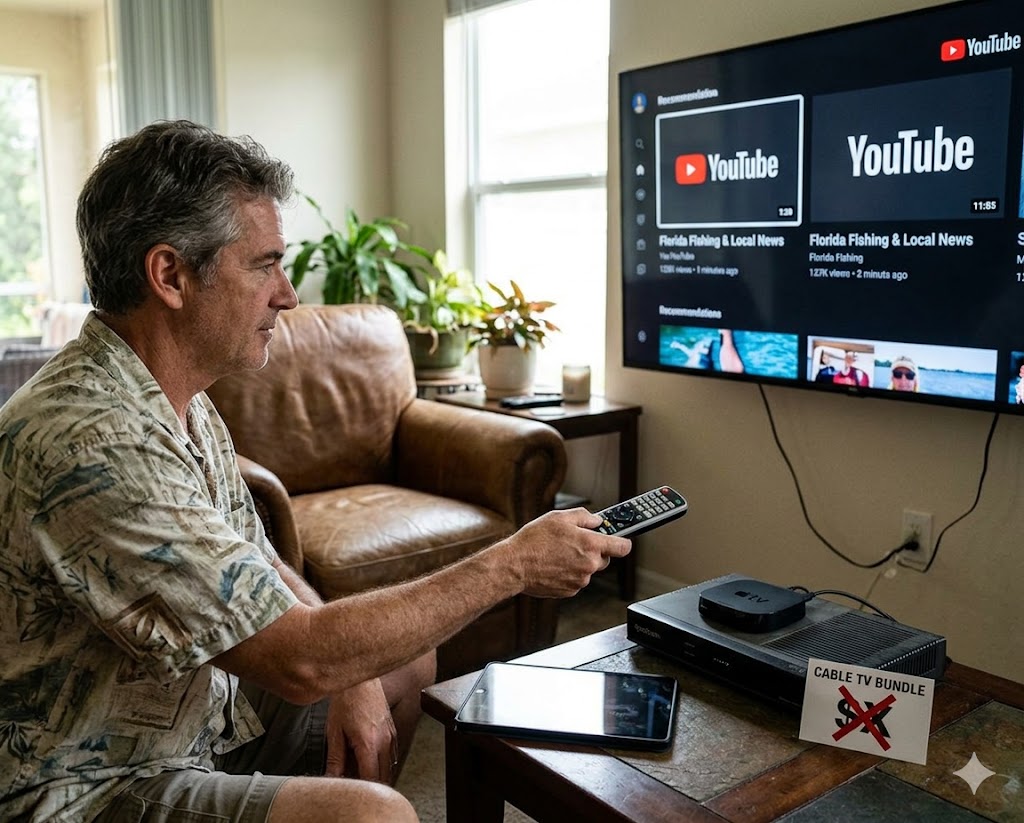
The cost pressure in this market is unlike almost anywhere else in Florida. Miami-Dade, Broward, and Palm Beach counties have experienced some of the steepest cost-of-living increases in the country over the past several years. Housing costs have pushed families further west — into Miramar, Pembroke Pines, Hialeah Gardens, Royal Palm Beach — where household budgets are stretched thin and monthly subscription audits happen out of necessity rather than preference. A cable bundle sitting at $160, $180, or more per month does not survive that audit when YouTube is free and the neighbor’s kid just explained how to set up a streaming account for $15.
Comcast Xfinity and DirecTV, the dominant cable and satellite providers across the tri-county area, have reported sustained subscriber erosion that accelerated rather than plateaued through the early 2020s. The response — price increases on remaining subscribers paired with promotional offers aimed at luring back churned customers — has produced diminishing returns in a market that has made its decision and largely moved on.
“South Florida cable customers did not leave angry. They left indifferent — which is a much harder problem to solve.”
YouTube Became South Florida’s Television Station
There is a generational divide in how this happened, and it is worth separating the two stories.
For South Florida residents under 40, YouTube was never a supplement to television. It was television. The generation that grew up in Doral watching Venezuelan YouTube creators, in Little Haiti consuming Haitian news channels unavailable on any cable lineup, in Kendall following Argentine comedy accounts, in Plantation subscribing to Nigerian gospel channels — that generation never developed the cable habit because YouTube was already giving them something cable structurally could not: content that reflected who they actually were, in the languages they actually spoke, from the cultures they actually came from.
Cable’s channel lineup was built for a homogeneous national audience that South Florida never was. YouTube’s infinite library was built for exactly the kind of market South Florida represents — fragmented, multilingual, globally connected, and deeply uninterested in being told what to watch and when to watch it. The fit was obvious in retrospect. The cable industry just did not see it coming because it was not looking at this market clearly.
For South Florida residents over 50 — the demographic cable spent years reassuring itself would never leave — the YouTube migration happened differently and more recently, but it happened just as completely. The platform’s aggressive push into long-form content, news commentary, home improvement programming, cooking channels, travel documentaries, and faith-based content delivered the living room television experience that older viewers wanted, without the cable bill attached to it. A retired schoolteacher in Delray Beach or a Cuban-American grandfather in Hialeah does not think of himself as a cord-cutter. He thinks of himself as someone who found what he was looking for on a free platform and stopped paying for something he no longer needed.
The advertising migration has compounded the damage to cable’s business model in ways that are difficult to overstate. South Florida’s enormous hospitality, real estate, healthcare, legal, and automotive advertising sectors — the categories that funded local cable’s economics — have shifted spending toward YouTube’s targeting capabilities with a directness that reflects how thoroughly the audience moved. A personal injury attorney in Coral Gables or a new development in Boca Raton can now reach exactly the South Florida households most likely to be relevant prospects, on the platform where those households are actually spending their time, at a cost that makes the old cable spot-buy model look like an antique.
Facebook and the Audience Nobody Expected to Lose
The most surprising cord-cutting story in South Florida is not the young professionals of Wynwood or the tech workers of Brickell deleting their cable apps. It is the retirees of Aventura, the Cuban-American community of Hialeah, the Haitian families of North Miami, and the Venezuelan diaspora spread across Doral and Weston who have made Facebook their primary window onto the world — and in doing so, quietly made cable news irrelevant to their daily lives.
Facebook cracked this market by doing something cable never managed: it made the content personal. A Hialeah grandmother does not watch a Facebook video because an algorithm served it to her. She watches it because her daughter shared it, because her church posted it, because the community group she follows in her neighborhood uploaded it. The content is embedded in relationships and community in a way that cable programming, for all its investment in personalities and production value, never achieved.
The Spanish-language Facebook ecosystem in South Florida is particularly formidable. Local political commentary pages, community news groups, and live-streamed town halls in Spanish have built audiences across Miami-Dade that dwarf the viewership of traditional Spanish-language cable broadcasts. Univision and Telemundo — cable’s answer to South Florida’s Hispanic market — are watching Facebook do to them exactly what they once did to English-language broadcasters: find the audience where it actually lives and serve it there.
Facebook Live has become the default broadcast platform for South Florida’s community institutions in ways that represent a genuine structural shift. City commission meetings in Hialeah and Doral, school board sessions in Broward County, hurricane preparedness briefings from county emergency management, church services from Little Haiti to Miramar — all of it streams live on Facebook to audiences that have no interest in finding it on cable and would not know which channel to look on if they tried.
“Facebook did not take South Florida’s cable audience by force. It simply became the place where South Florida’s communities actually talked to each other — and the audience followed the conversation.”
The Two Things Keeping Cable on Life Support
South Florida’s cable providers still have a pulse, and two specific things are keeping it beating.
Live sports is the more powerful of the two. This is a market that takes its sports seriously — the Miami Heat, the Dolphins, the Marlins, the Inter Miami soccer club, and the Panthers in Broward County all command audiences willing to maintain cable subscriptions specifically to watch live games. The broadcast rights ecosystem that keeps premium sports behind pay-television walls has been cable’s most effective retention mechanism in South Florida, and it is not an exaggeration to say that without live sports, the subscriber decline curve would be significantly steeper than it already is.
The second lifeline is hurricane coverage. South Florida sits in one of the most active hurricane corridors in the Western Hemisphere, and when a serious storm threatens the coast, something interesting happens — people who have not watched local television in months turn it back on. The institutional knowledge embedded in South Florida’s local TV meteorologists, the muscle memory of watching storm coverage on a large screen with the family gathered, and the reliability of broadcast signals when internet infrastructure is compromised all give local television a recurring moment of necessity that no platform has fully replaced. It does not save cable. But it slows the bleeding every June through November.
The Journalism Nobody Is Paying For
Behind the subscriber charts and the platform migration statistics is a quieter story that South Florida residents deserve to hear plainly: the collapse of cable television’s economic model is accelerating the collapse of local journalism, and the platforms replacing cable are not replacing what local journalism actually does.
South Florida has historically been underserved by investigative local journalism relative to its size and complexity. The region’s government corruption record, its real estate finance ecosystem, its immigration policy implications, its environmental pressures from sea level rise and Everglades restoration — all of it requires sustained, resourced, credentialed journalism to cover adequately. The local television stations and cable news operations that once provided some of that coverage are operating with fewer reporters, smaller budgets, and less editorial independence than at any point in recent memory.
YouTube’s South Florida creators are talented, entrepreneurial, and deeply connected to their communities. They cover what they care about and what their audiences engage with. They do not attend county budget hearings, review municipal bond offerings, or file public records requests against resistant government agencies. That work requires institutions, and the institutions are shrinking.
Facebook’s community groups surface genuine local information and connect neighbors in ways that have real value. They also spread misinformation at scale, amplify outrage over accuracy, and have no editorial accountability to the communities they serve. The replacement is not equivalent, and South Florida’s residents will feel that gap more acutely as the years go on.
The Signal From Here
Cable television in South Florida is not collapsing dramatically. It is fading — the way a tide goes out, steadily and without drama, until you look up and realize the waterline is nowhere near where it used to be.
The audience is not gone. South Florida’s screens are more active than ever, its appetite for video content is enormous, and its residents are consuming more media hours per day than at any point in the history of the medium. The attention is simply somewhere else — fragmented across platforms that are more responsive, more personal, more affordable, and more linguistically inclusive than cable ever managed to be in a market that demanded all four.
For the cable industry, the prognosis in South Florida is not recovery. It is managed decline — a slow repositioning toward broadband internet provision while the video product that built the business continues its long goodbye.
For South Florida residents, the transition is largely complete. The only question left worth asking is not where the audience went. It is what gets lost in a community when the economic model that paid for accountability journalism disappears — and whether anyone will notice until it is too late to rebuild it.
South Florida News Blog. This article is an independent editorial overview drawing on publicly available industry data, platform research, and regional media reporting. All observations reflect general trends current as of 2026.
About Brian French
Led by a commitment to tech-intelligent curation, Brian French tracks and analyzes the Business News in South Florida including corporate developments defining Florida's economy. Brian brings an extensive financial background to his analysis, having graduated from the University of South Florida in Finance and serving as a Vice President and Portfolio Manager for Merrill Lynch Private Investors and the Trust Department in St. Petersburg, FL, as well as a Vice President and Trust Investment Officer for SunTrust Bank in Sarasota, FL. His writing blends macroeconomic trends, capital markets, corporate strategy, and modern digital insights for a sophisticated look at Florida's dynamic business economy.